
Equipment
0-150 V
bank voltage range
0.5-5.0 ms
timing delay, adjustable
0-30 J
actuator energy into 0.6 ohms
3 + 3
capacitor banks, Regular and Heavy Duty
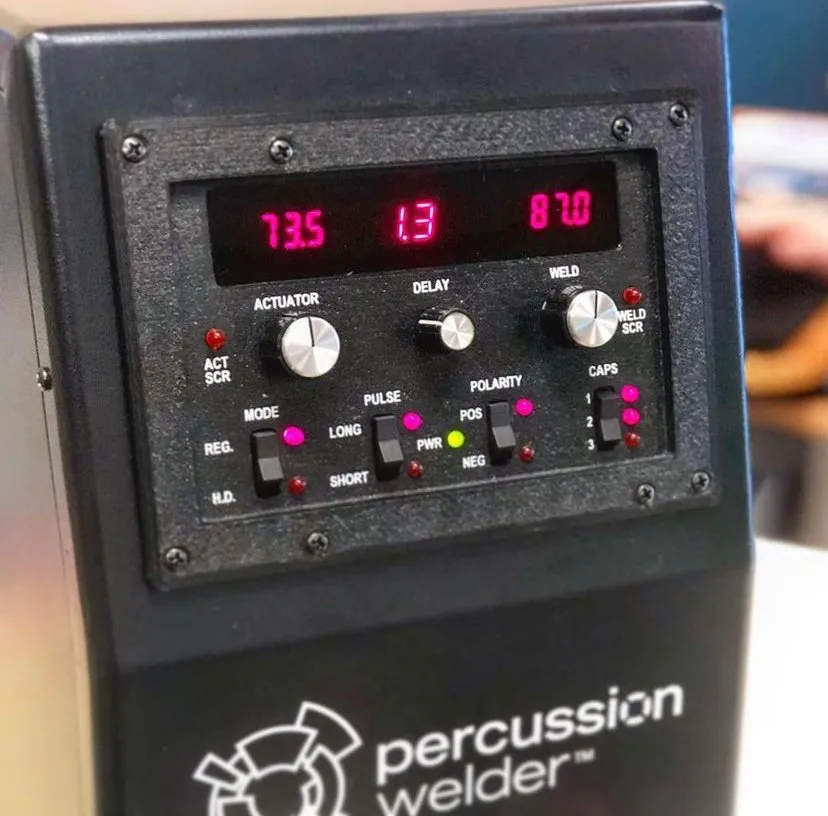
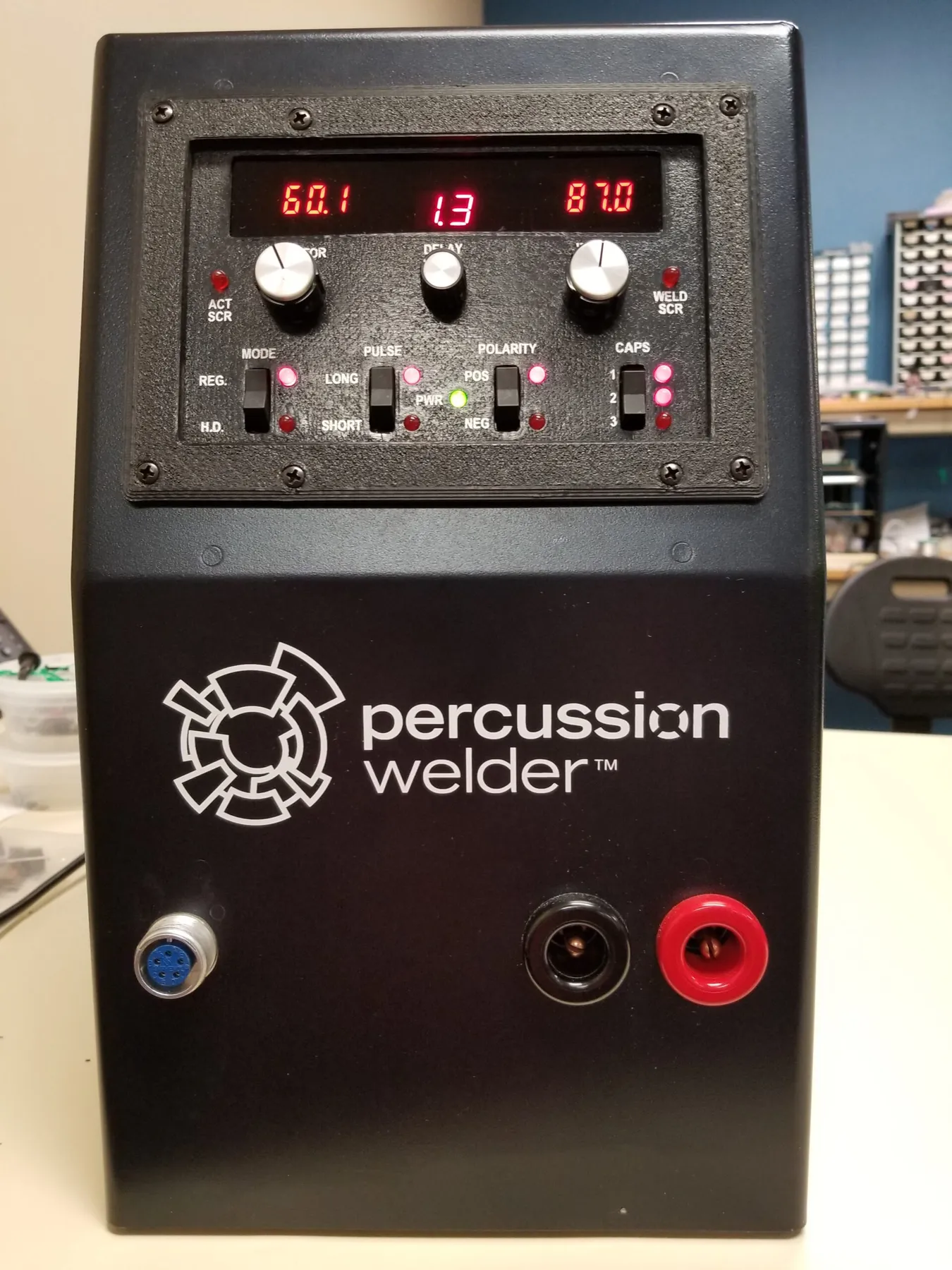
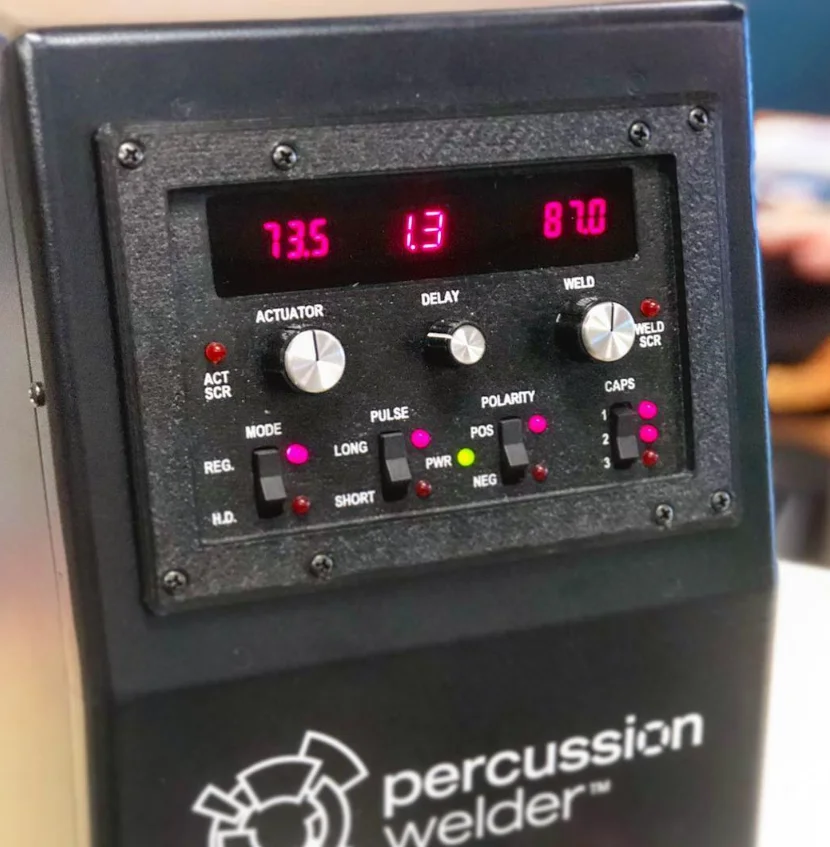 The 858 front panel
Anatomy
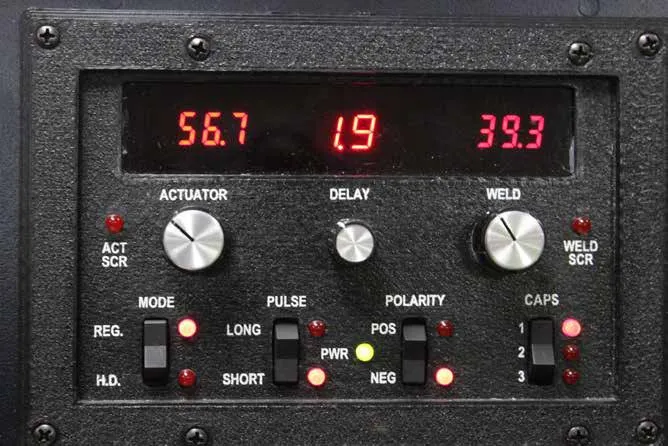
The 858 front panel, control by control
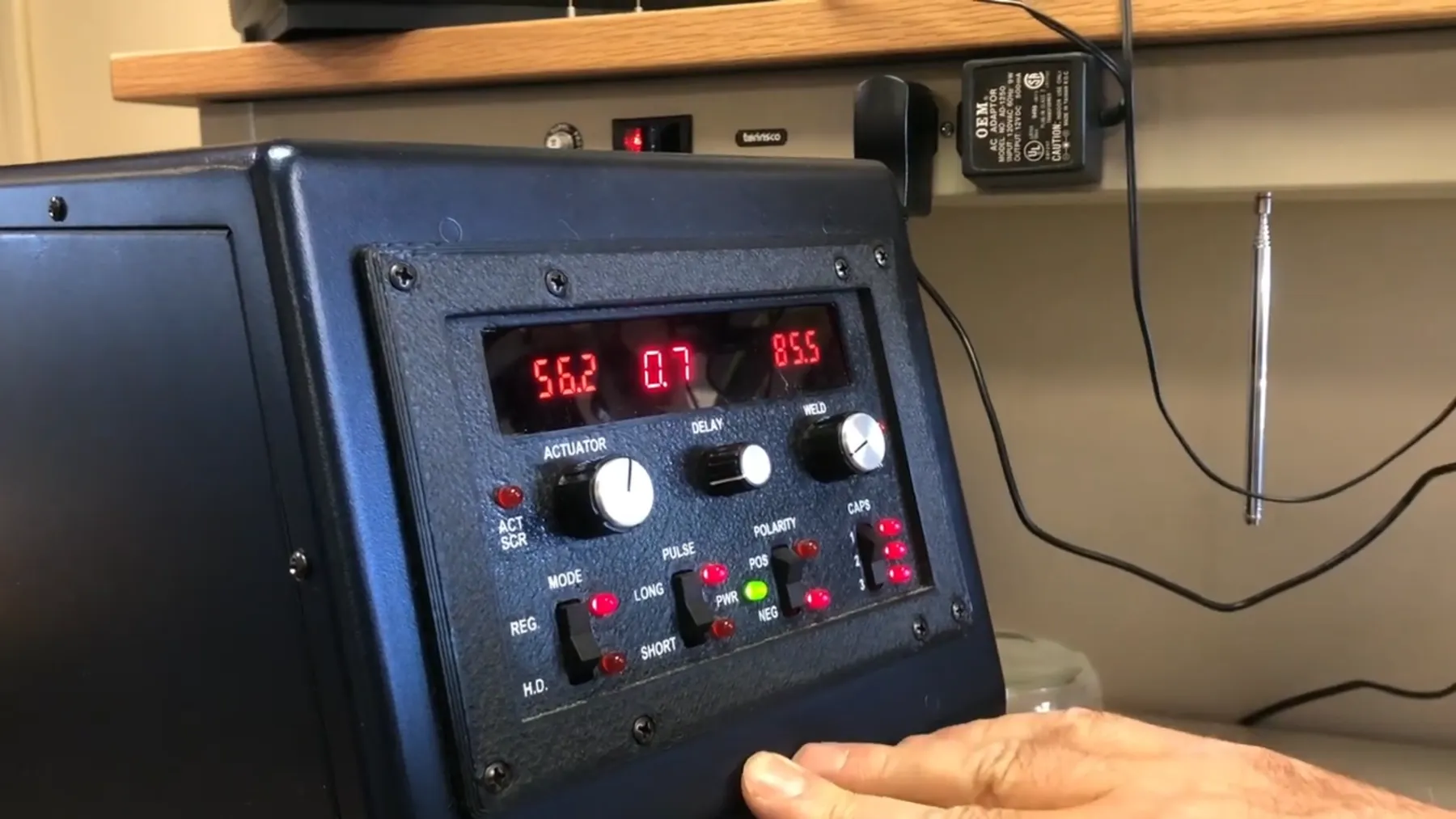
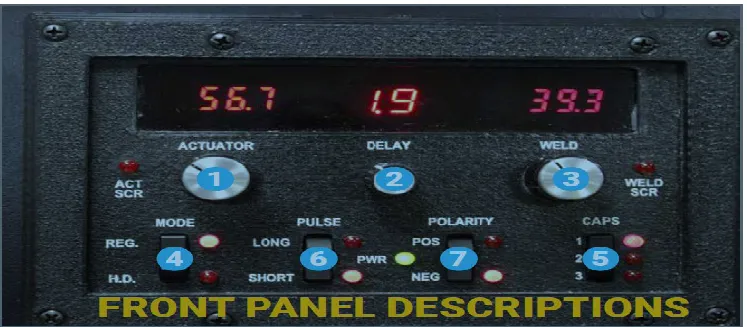
Tap a point on the panel. Each lab weld schedule is a set of these controls: actuator, delay, weld voltage, capacitance and pulse.
Actuator
Actuator dial
Sets the voltage applied to the actuator, which sets how fast it drives the moving wire holder.
The values on the display are an example setting, not a recommendation. Lab starting points are in the Parameter Finder.
The 858 is a precision capacitor discharge micro welder built for joints such as thermocouple wire, dissimilar metals, and fine-wire assemblies where heat damage, contamination, and inconsistent results aren't options.
Unlike spot welding (which presses two materials together with current), arc welding (which uses sustained electrical arcs), or flash welding (which fuses entire surfaces with high pressure), percussion welding releases a millisecond burst of energy from a capacitor bank to forge two materials together with a minimal heat-affected zone. The result: cleaner welds, no filler material, and the ability to join dissimilar metals.
The 858 is used for thermocouple welding, fine-wire joining, and dissimilar metals welding in aerospace, defense, electronics, battery, and industrial sensor applications.
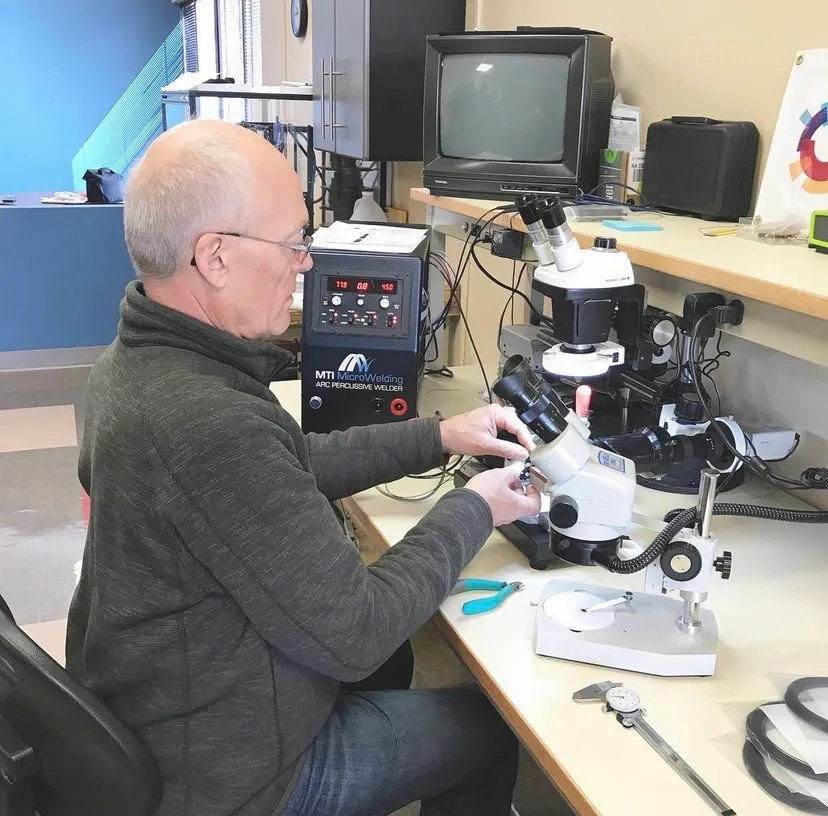
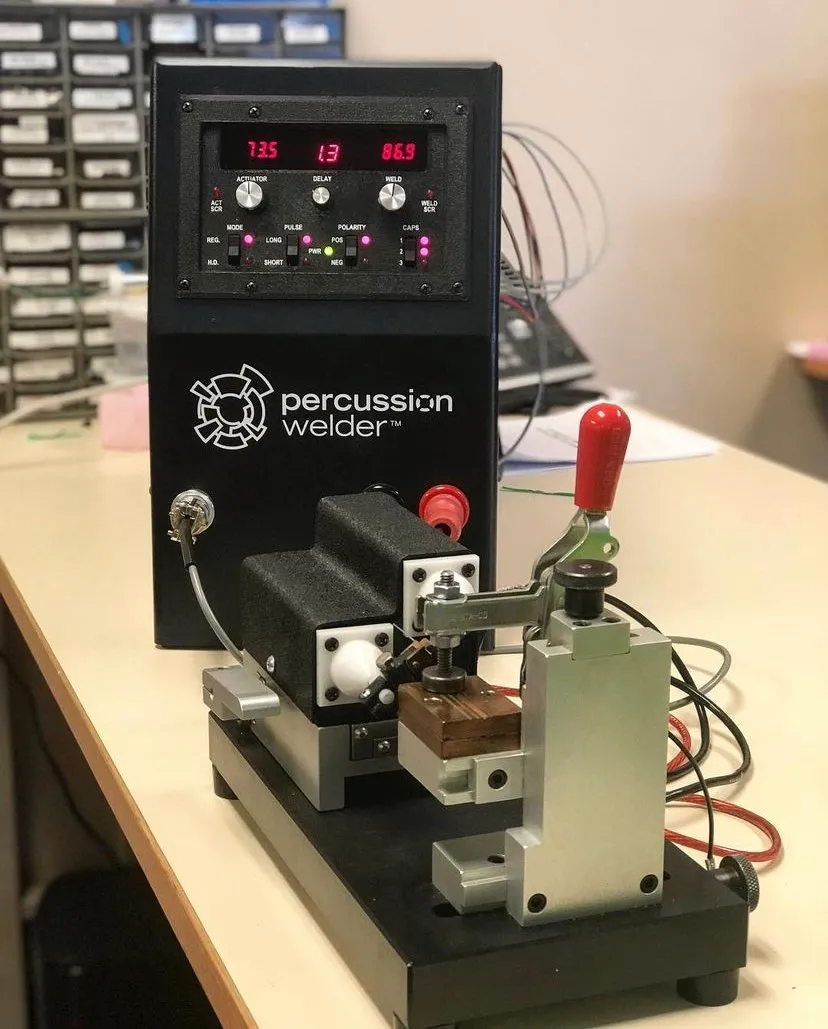
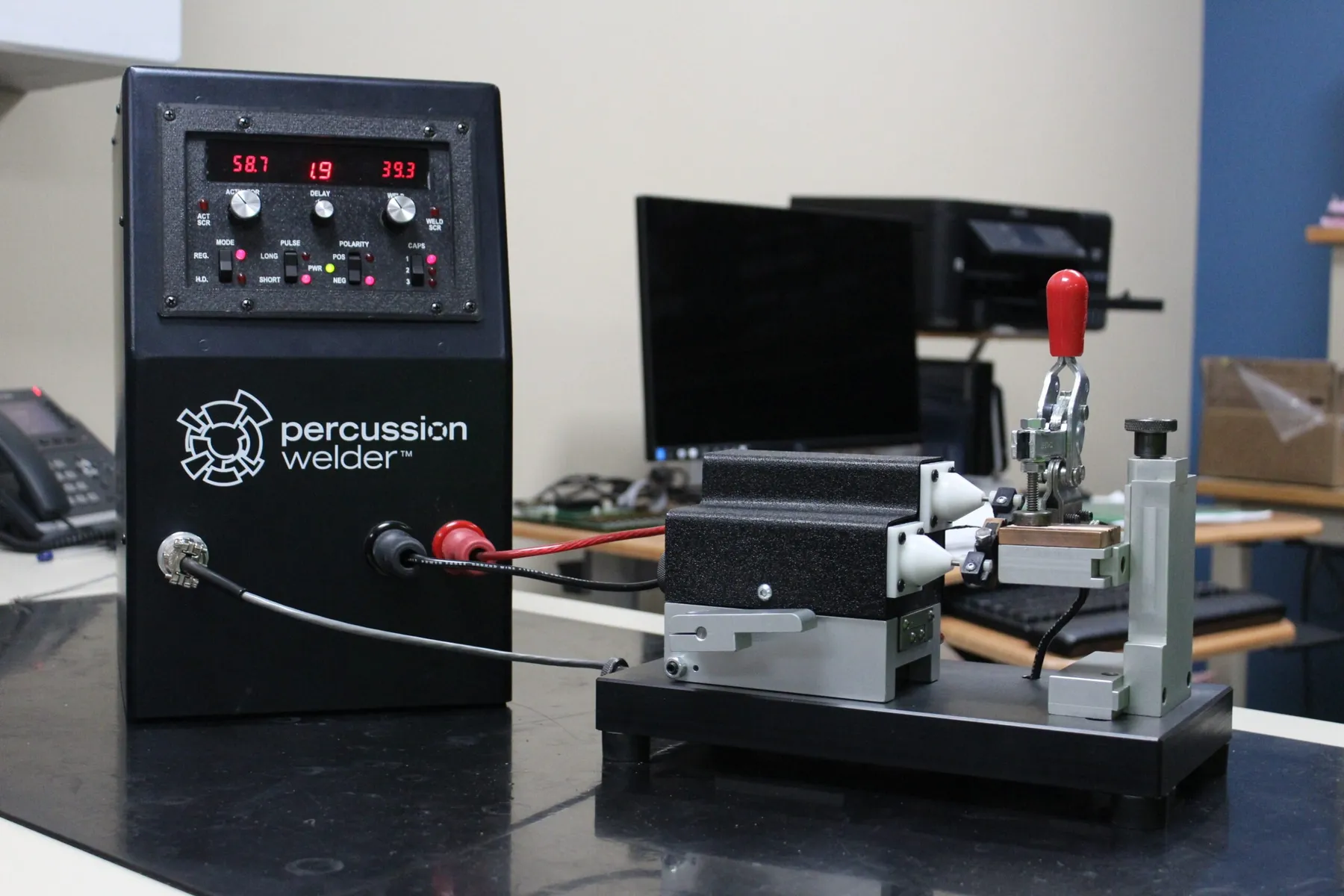
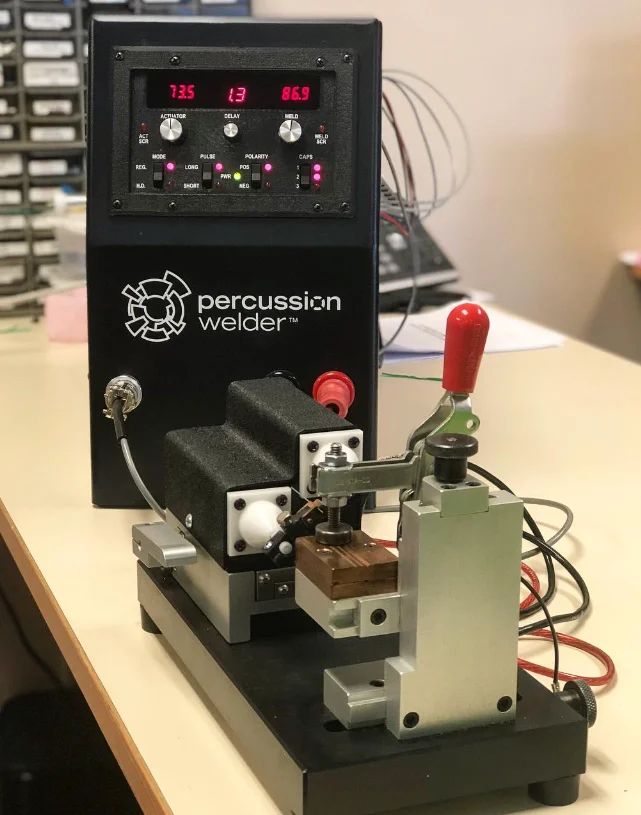 858 and 726 fixture on the bench
Chapter 01 / 03
Our Micro Wire Welding Machine Process
The Percussion Welder Model 858 is a micro arc welding machine. It allows two wires of similar or dissimilar metals to be welded together quickly, efficiently, and with precision and control.
The Model 858 is the control system for the bench unit, and it offers precision adjustment for different metals, diameters of materials, and the specific current required for the process. This control over the micro welders equipment is user-friendly, with dial control over the actuator, delay, and weld energy voltage control.
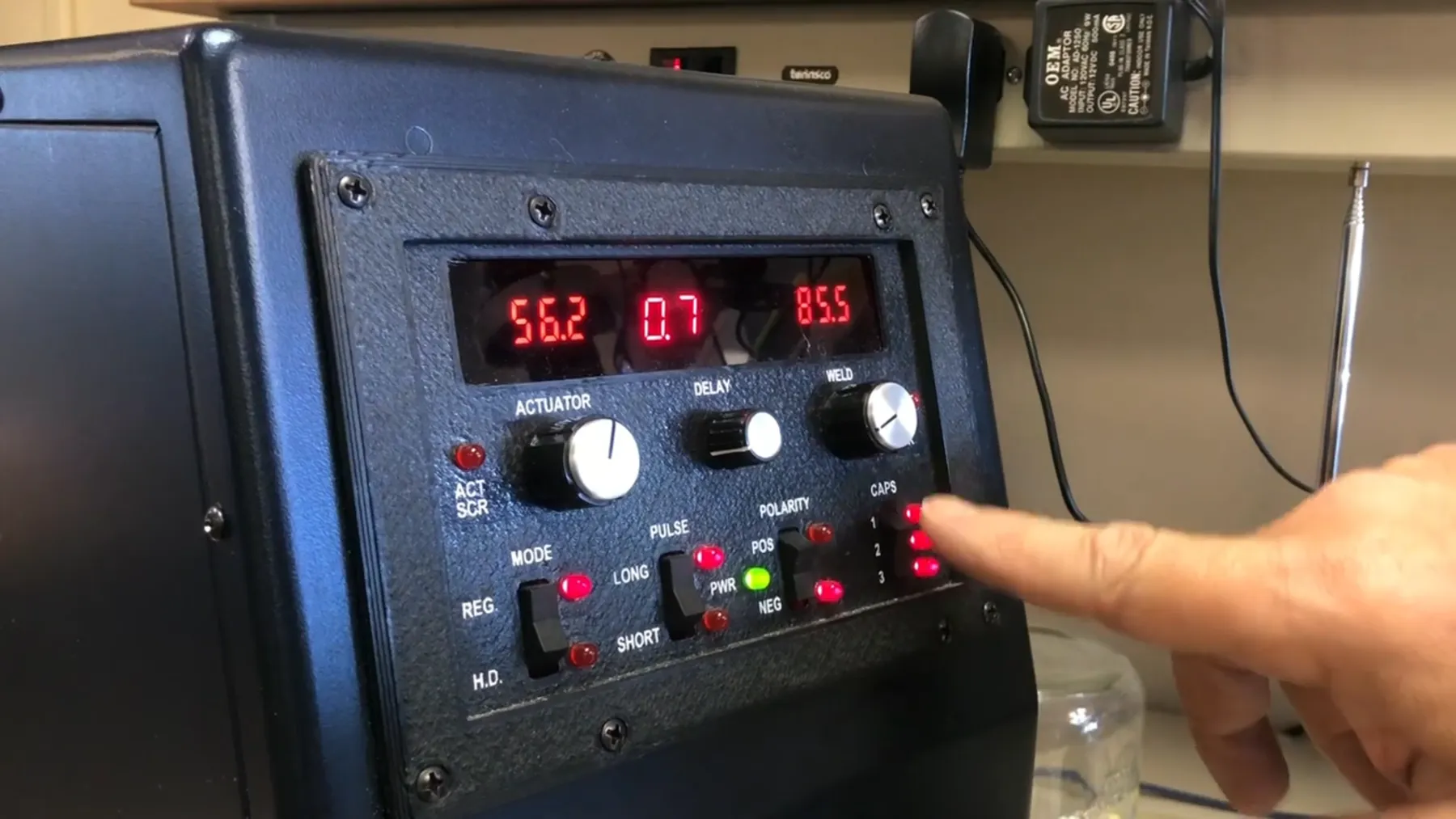
The user can also adjust the mode, pulse, polarity, and capacitance for each weld using clearly marked switches on the panel. The system is ready to use upon arrival, and with intuitive operation, our micro spot welding machine is easy to integrate into any process.
Our mirco welding equipment is ideal for manual operation, but it is easily adaptive and integrated into automated production lines and processes. The Model 858 micro welding machine system comes with the Model 726 Bench Fixture and the optional Percussion Weld Monitor that tests welds for customizable good/no good quality control.
If you have any questions about our micro welding machines, or if you are struggling to find a micro welding solution, call us at 303-536-7838 or reach out to us online.
Control Features
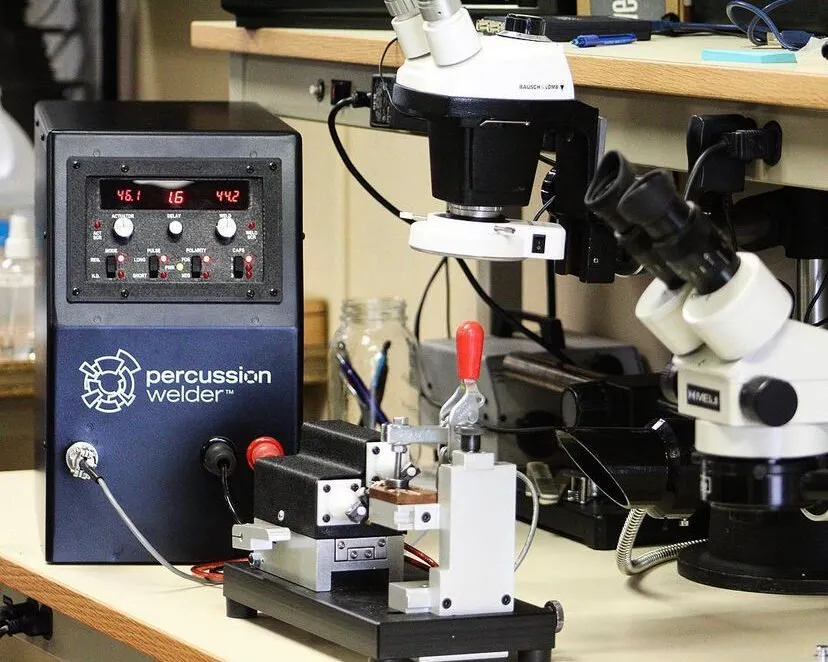
The 858 Percussion Welder offers a suite of advanced control features that make it a tool for precision micro-welding. The front panel is equipped with user-friendly controls that allow operators to fine-tune every aspect of the welding process. From adjusting the actuator and delay settings to controlling the weld energy voltage, the 858 provides precision and flexibility.
Operators can select from various mode settings, including regular and heavy-duty, to match the requirements of their specific application. The ability to control pulse width, polarity, and capacitance lets operators tune each weld to the application. These features make the 858 Percussion Welder a versatile solution for a wide range of micro-welding tasks.
| SPECIFICATIONS | |
| AC Input: | 110-120 VAC 60 Hz 20 amp peak; 200~220 VAC 50~60 Hz 10 amp peak |
| Circuit Protection: | 10 amp or 20 amp fuse (see above) |
| Capacitance: | Regular: Bank 1 330 µF Bank 2 1,830 µF Bank 3 8,430 µF Heavy Duty: Bank 1 10,230µF Bank 2 11,730µF Bank 3 18,330µF |
| Bank voltage range: | 0-150V |
| Repetition rate: | |
| Timing Delay: | 0.5 to 5.0 milliseconds |
| Triggering: | Closed contact 15v |
| Polarity: | Positive or Negative: User Selectable |
| Actuator Energy: | 0 to 30 Joules into 0.6 ohms |
| Actuator Speed: | 0-33 in/per sec. (0-150V) |
| Cooling: | Fan forced air |
| Dimensions: | 9”W X 15”H X 20”D (229mm) (381mm) (508mm) |
| Weight: | 35lb (16kg) |
Chapter 02 / 03
What the 858 Welds
The 858 handles applications that conventional welders can't:
Thermocouple wire welding — junction welds with no filler and millisecond cycle times.
Dissimilar metals joining — copper to stainless, aluminum to steel, platinum to nickel, and refractory pairings.
Fine-wire assemblies — wires from 0.001" to 0.040" diameter, including magnet wire and lead wire.
Battery tab welding — copper, nickel, and aluminum tabs to cell terminals with a minimal heat-affected zone.
Heater element & resistance wire — nichrome, kanthal, and other resistance alloys joined to lead wire with low added joint resistance.
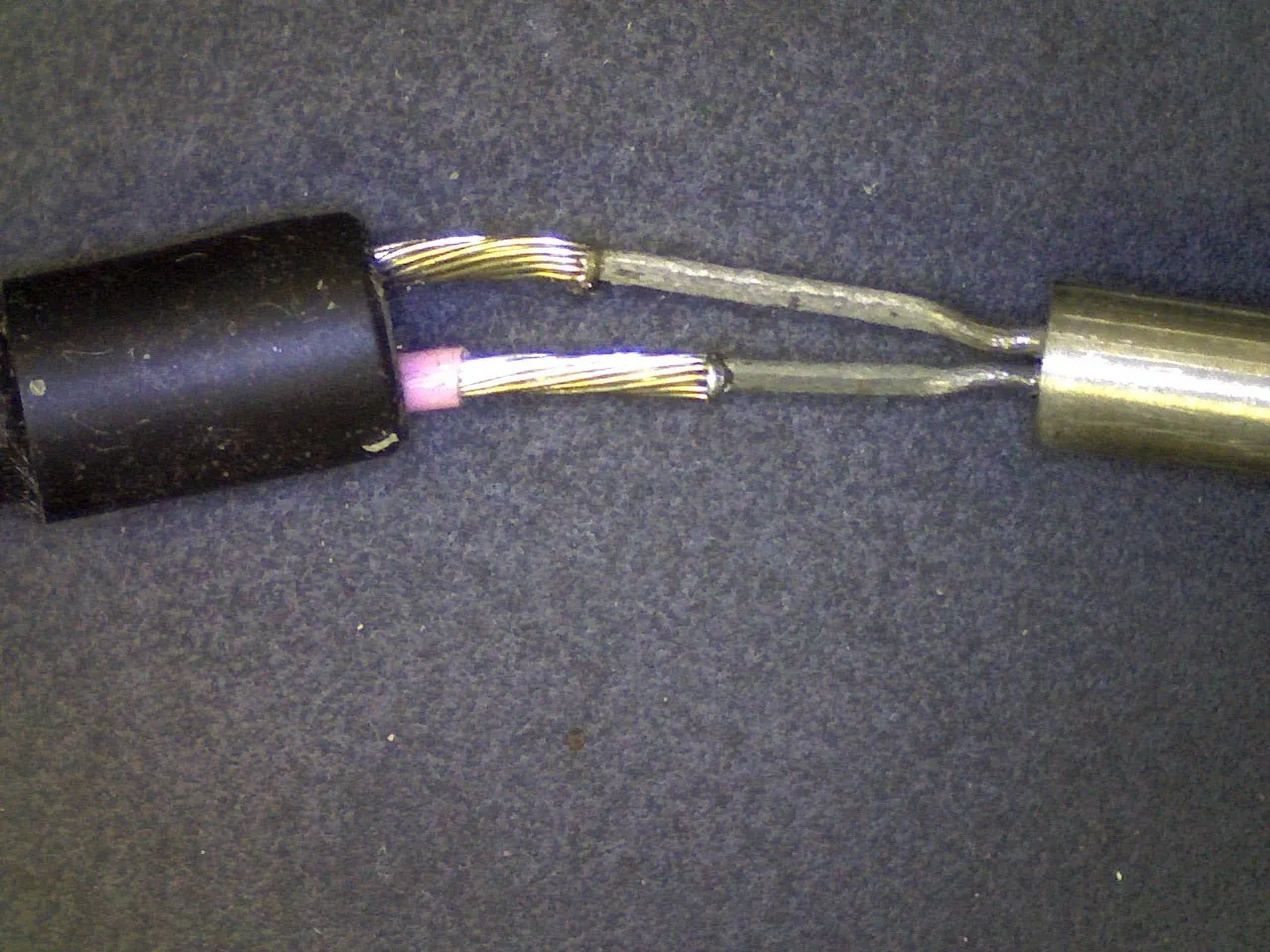
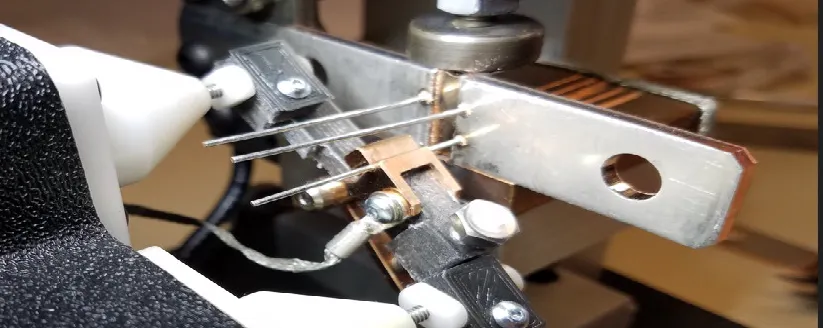
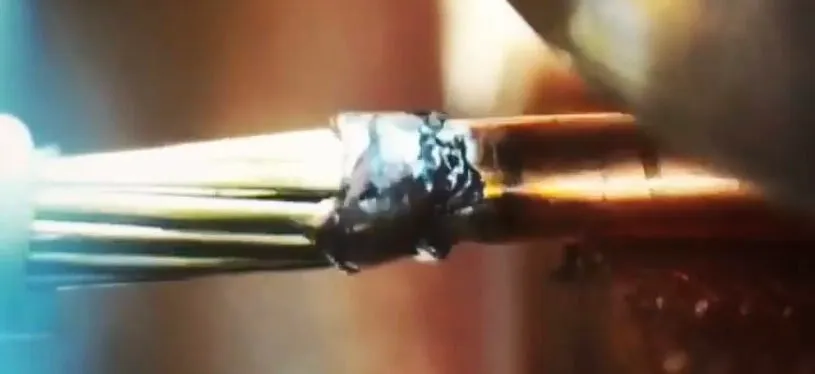
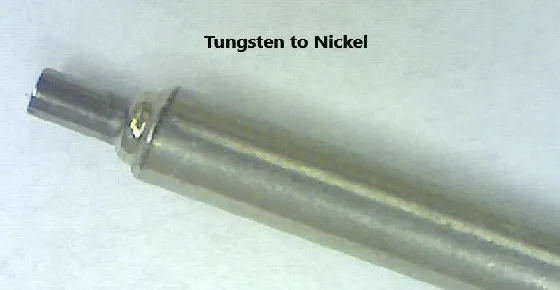
Gallery
The 858 on the bench
Power supply, fixture, and the joints they make.

Chapter 03 / 03
Ask for a Demonstration
If you’re like us, sometimes a picture (or video) is worth a thousand words. Watch our video showing you step-by-step how easy Percussion Welder 726 Bench fixture is to operate.

Where to next
Battery Tab Welding with Percussion Welding
Tab welding for batteries: percussion welding joins copper, nickel and aluminum tabs with no filler and a minimal heat-affected zone. Lab schedules and a free test.
Open →Thermocouple Welder: Percussion Welding for Thermocouple Wire
Weld thermocouple junctions with the Model 858: no filler, solder or crimping, a minimal heat-affected zone, and lab schedules for Chromel, Alumel and more.
Open →726 Bench Fixture
The Model 726 Bench Fixture is the weld head of the Percussion Welder system: it holds, aligns and thrusts small parts together, with the 858 and 808.
Open →Percussion Weld Monitor
The Percussion Weld Monitor learns a signature waveform for your product, then tests production welds against it with pass/fail output and QC data.
Open →FAQ
What is a thermocouple welder?
A thermocouple welder is a precision welding machine designed to join the two dissimilar wires that form a thermocouple junction (such as Type K, J, or T). The 858 uses capacitor discharge to fuse the wires in milliseconds without filler material and with a minimal heat-affected zone.
How does a percussion welder differ from a micro spot welder?
A micro spot welder presses two materials between electrodes and passes current through them, creating a fused spot. A percussion welder uses a capacitor to discharge a precisely controlled burst of energy across a small gap, forging the materials together with mechanical motion. Percussion welding produces a minimal heat-affected zone, doesn't require electrode contact pressure, and joins dissimilar metals that spot welders struggle with.
What materials can the 858 weld?
Copper, stainless steel (300 and 400 series), nickel and nickel alloys, platinum, gold, silver, aluminum, titanium, kovar, MP35N, nichrome, kanthal, and most thermocouple alloy combinations. The 858 handles dissimilar pairings.
What wire diameters does the 858 handle?
0.001" to 0.040" diameter.
Does the 858 require operator certification?
No — the 858 is designed for intuitive manual operation with minimal training. The optional Percussion Weld Monitor provides automated good/no-good quality control. Ask us about your specific production-environment requirement.
What does the 858 ship with, and can it run on a production line?
The system is ready to use on arrival and comes with the Model 726 Bench Fixture and the optional Percussion Weld Monitor. It suits manual operation and can be integrated into automated production lines. Call 303-536-7838 to discuss your setup.
Still have a question? Tell us your weld challenge and an engineer will reply.
Start here
Send us your wire, tab or thermocouple pair and we will weld it on the 858 at our Denver lab.
Prefer to talk? Book a demo or call 303-536-7838