
Medical
4 families
instruments, implants, machinery, electronics
No filler
strong welds on dissimilar materials
Minimal HAZ
helps protect sensitive materials
Since 1990
MTI Micro-Welding, ISO 9001
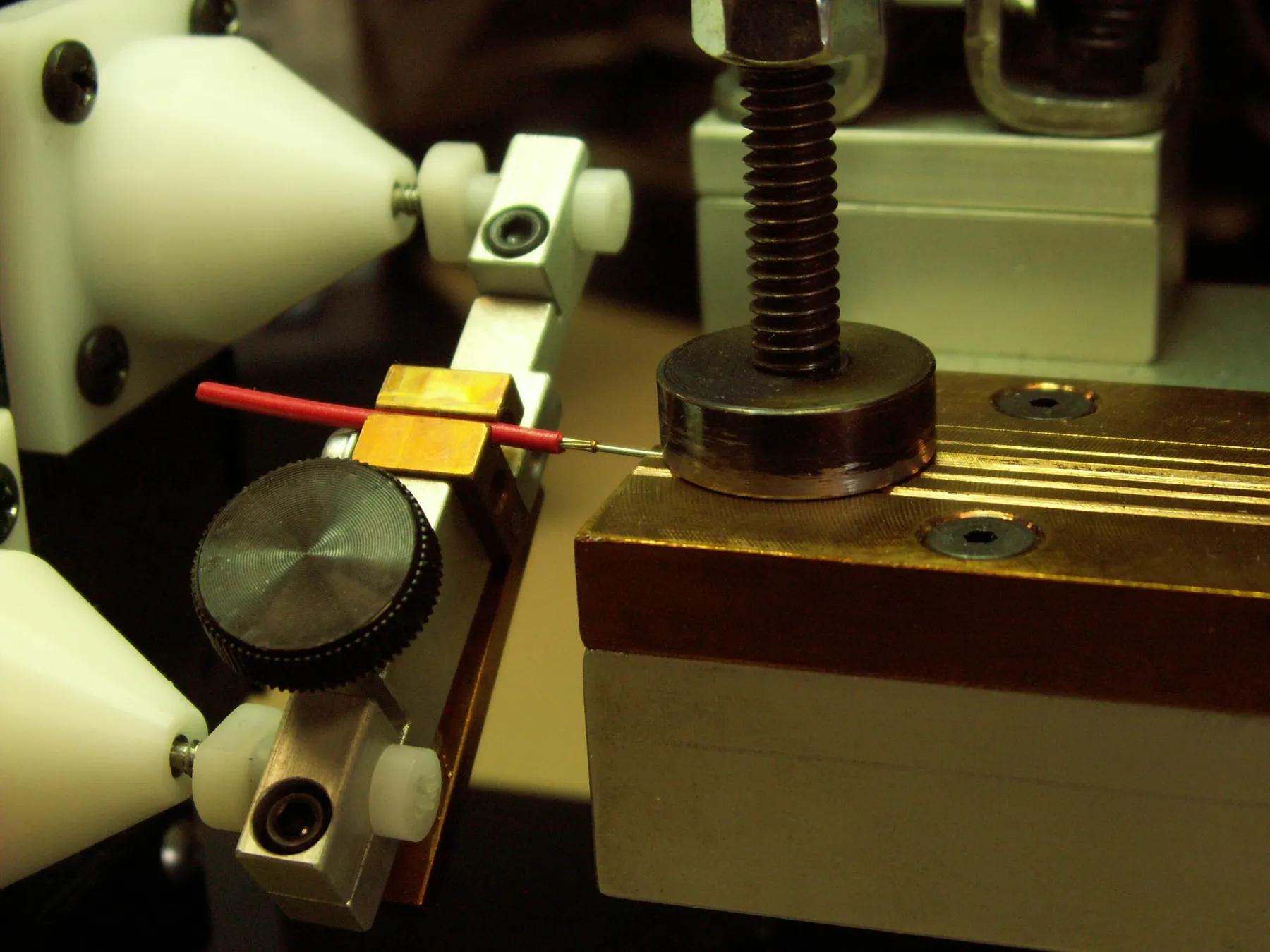
Extreme close-up of 18 AWG stranded copper wire being welded to a stainless steel three-wire twist.
Chapter 01 / 08
Percussion welding in medical device manufacturing
Percussion welding is used for medical device components. The process produces a minimal heat-affected zone and joins dissimilar metals without filler, flux or solder.
Medical devices are often small and intricate, which makes them hard to weld. They need low electrical resistance and high reliability, and they are usually made of dissimilar materials and complex components. Percussion Welder, part of MTI MicroWelding, has supported engineers with medical products since 1990.
Chapter 02 / 08
Medical device parts we join
A wide range of device components are joined with the percussion welder. These products are often made of dissimilar materials and need precise welding:
- Surgical instruments
- Implants
- Medical machinery
- Medical electronics
Many of our customers are under non-disclosure agreements, so we do not publish customer names or part drawings. Ask us about your specific requirement.
Want to see it on your parts?
Send samples and we'll run test welds before you commit.
Gallery
Fine-wire joining up close
Bench fixture and weld photos from our lab. Parts shown are lab samples, not medical devices.

Chapter 03 / 08
Where percussion welding fits among medical welding methods
Laser, resistance (spot) and TIG welding are all used on medical parts, and each suits certain joints. The right choice depends on the joint: the size of the parts, whether the metals match, how much heat the surrounding material can take, and whether filler, flux or solder is acceptable.
Percussion welding fits best when:
- the parts are very small, such as fine wire, pins and thin material;
- the two metals are different, for example copper to stainless steel;
- heat must stay out of the surrounding part;
- no filler, flux or solder is acceptable in the joint.
It is not the answer to every joint. It is a small-scale process: thick sections and large joints are outside its reach. If another process suits your part better, we will tell you so.
Chapter 04 / 08
Heat and small parts
On a small part, heat that spreads even a little reaches a large share of the device. Percussion welding heats for milliseconds, so there is very little time for heat to leave the joint.
See how heating time changes how far heat can spread in your metal with the heat spread calculator.
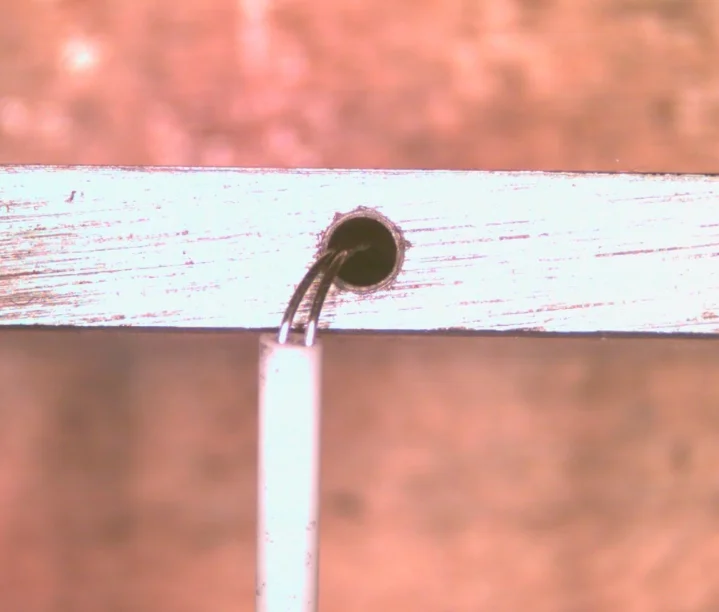 Type K thermocouple wires welded at the bottom of a 1/16" hole in a stainless steel plate
Chapter 05 / 08
Materials
Percussion welding can join materials commonly used in medical devices, including stainless steel and titanium. Our lab database holds schedules for stainless steel with aluminum, copper, elimar, nickel, tungsten. These are starting points, not guarantees, and every medical application is validated on the customer's own parts.
Check your pair in the material compatibility checker, or open the Parameter Finder.
Want to see it on your parts?
Send samples and we'll run test welds before you commit.
Chapter 06 / 08
Checking and documenting welds
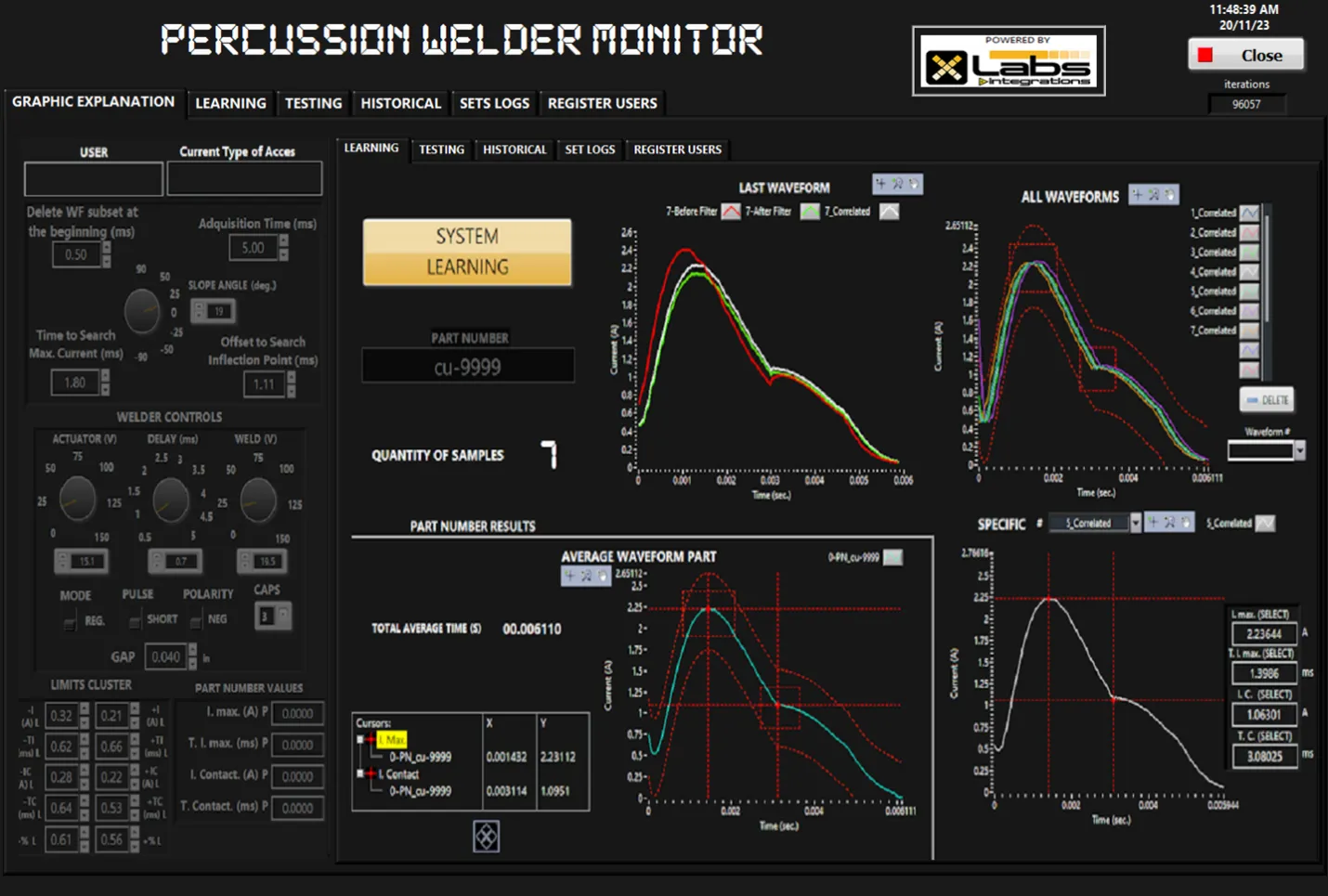
The Percussion Weld Monitor adds automated good/no-good checking to the process: it learns what a good weld looks like, then compares every weld against tolerances you set. It is a tool for process development and for production monitoring, and it can store weld data and waveforms.
The monitor does not replace validating joint strength on your own parts. See the Percussion Weld Monitor.
Chapter 07 / 08
Quality and requirements
MTI MicroWelding is certified to ISO 9001:2015 with Design. For specific certifications, regulatory or validation requirements on your device, ask us about your requirement. See the quality documents.
Chapter 08 / 08
Start with a test
Free applications tests of your materials are available, and we can run live, in-person tests at our lab at 7100 N Broadway in Denver. Tell us the materials and the wire or pin sizes, call 303-536-7838, or tell us your weld challenge.
Topic guide
Medical Device Welding: articles
Where to next
858 Percussion Welder
The Model 858 is a capacitor discharge micro welder for thermocouple wire, fine wire and dissimilar metals. No filler, minimal HAZ. Call 303-536-7838.
Open →Percussion Weld Monitor
The Percussion Weld Monitor learns a signature waveform for your product, then tests production welds against it with pass/fail output and QC data.
Open →Material compatibility checker
Open →HAZ calculator
Open →FAQ
What medical parts are joined with percussion welding?
Surgical instruments, implants, medical machinery and medical electronics. These products are often made of dissimilar materials and need precise welds.
Which materials can be welded in medical devices?
Stainless steel and titanium are examples used in medical devices. Percussion welding can join dissimilar materials without filler.
Why does heat input matter on medical parts?
A minimal heat-affected zone helps protect sensitive materials. Medical devices are small and intricate, so excess heat is hard to tolerate.
Is it suitable for high-volume production?
Yes. Micro welding with percussion welding suits high-volume production because of its efficiency, precision and compatibility with automated systems.
Can it be used for R&D and custom devices?
Yes. Micro welding can be used for medical R&D and for customized devices.
Can I try my own part first?
Call 303-536-7838 or use the contact page. The team can discuss your material pair and run tests on their equipment.
Still have a question? Tell us your weld challenge and an engineer will reply.
Start here
Tell us the materials and wire or pin sizes, and we will talk through what a percussion weld can do with them.
Prefer to talk? Book a demo or call 303-536-7838