
Insights
March 1, 2024 · 7 min read · Process
Perceive the world of percussion welding, a method that joins two metal pieces together using high-velocity impact. This blog post aims to provide a comprehensive understanding of the basics and benefits of percussion welding. From the fundamental principles to the advantages it offers over traditional welding methods, this article will equip you with the knowledge necessary to grasp the potential applications of percussion welding in various industries. Whether you are a welding enthusiast or a professional seeking to expand your welding repertoire, this introductory guide will lay the groundwork for your exploration of this innovative welding technique.
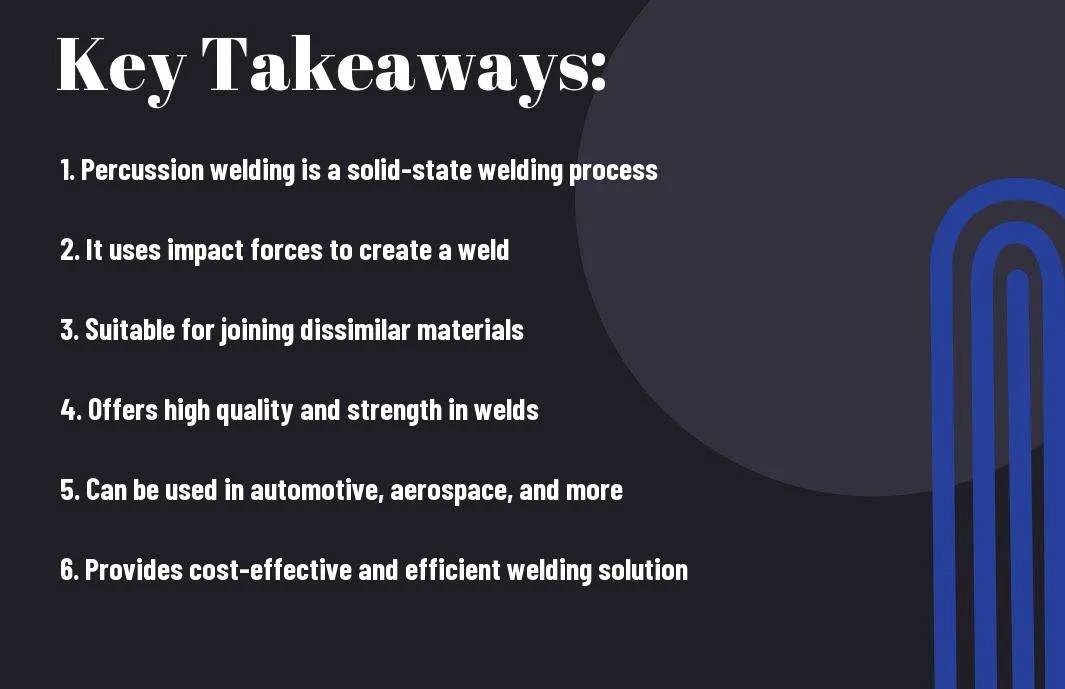
Key Takeaways:
- Benefits of percussion welding: Percussion welding offers several benefits, such as fast welding speed, minimal heat input, and the ability to weld dissimilar metals.
- Understanding the process: Percussion welding involves the use of controlled force to create a weld, making it a reliable and consistent welding method.
- Applications of percussion welding: This welding technique is commonly used in automotive, aerospace, and electronics industries for its precision and efficiency.
Chapter 01 / 04
Basics of Percussion Welding
One of the most efficient methods of joining metals together is through percussion welding. This process involves the use of rapid, controlled impact energy to create a solid-state bond between two metal surfaces, resulting in a strong and reliable weld.
Definition and Principle
On a fundamental level, percussion welding works based on the principles of kinetic energy. The process involves the use of high-speed impact energy to forge a connection between the metal surfaces. By applying controlled force and pressure, the kinetic energy generated during the impact fuses the metals together, creating a strong and seamless weld. Furthermore, percussion welding is a solid-state joining process, which means it does not involve the melting of the base metals. Instead, the weld is formed through the plastic deformation of the materials, resulting in a bond that retains the original properties of the metals and minimizes the potential for distortion or heat-affected zones.
Equipment and Materials Used
On a practical level, percussion welding requires specialized equipment, including a welding machine and anvil. The welding machine delivers the controlled impact energy, while the anvil provides support for the workpieces during the welding process. For instance, the materials used in percussion welding typically include various metals such as steel, aluminum, and copper. These materials should possess compatible properties to ensure the formation of a strong and durable weld.
Chapter 02 / 04
Process and Techniques
To achieve successful percussion welding, it is essential to understand the various processes and techniques involved in the method. Whether you are new to percussion welding or a seasoned professional, mastering the preparation, setup, welding cycle, and post-welding procedures is crucial to ensuring high-quality welds and efficient operations.
Preparation and Setup
For optimal results in percussion welding, thorough preparation and setup are imperative. This includes selecting the appropriate materials, ensuring they are clean and free from any contaminants, and setting up the welding equipment according to the specific requirements of the workpiece. Additionally, proper alignment and fixture support are critical to the success of the welding process. A meticulous approach to preparation and setup lays the foundation for a precise and effective welding operation. Any deviation from the proper welding cycle can result in flawed welds, increased rework, and potential equipment damage. It is essential to adhere to the specific welding cycle parameters, including the initiation of the weld, forging and cooling stages, and post-forging heat treatment. By understanding and meticulously executing each phase of the welding cycle, welders can consistently achieve high-quality, durable welds with minimal defects.
Post-Welding Procedures
For a comprehensive percussion welding process, post-welding procedures play a crucial role in ensuring the integrity and longevity of the weld. This includes inspecting the weld for any defects, conducting non-destructive testing, and applying any necessary finishing processes to meet the required specifications. Furthermore, proper documentation and traceability of the welding process are essential for quality control and compliance purposes. With precise execution and adherence to standard post-welding procedures, any potential issues such as cracking, distortion, or inadequate weld strength can be identified and addressed promptly, ensuring the overall quality and reliability of the welded components. An organized and strategic approach to post-welding procedures contributes significantly to the overall success of the percussion welding process.
Want to see it on your parts?
Send samples and we'll run test welds before you commit.
Chapter 03 / 04
Benefits of Percussion Welding
Your manufacturing process can greatly benefit from the use of percussion welding. This advanced welding technique offers several advantages over traditional methods, including enhanced speed and efficiency, versatility in applications, and exceptional quality and durability of welds.
Speed and Efficiency
To improve productivity and reduce production time, percussion welding offers unparalleled speed and efficiency. This welding method allows for quick and precise bonding of materials, resulting in faster assembly and reduced labor costs. By eliminating the need for filler materials and pre-cleaning of surfaces, percussion welding streamlines the welding process, making it an ideal choice for high-volume production environments. Furthermore, the ability to weld dissimilar metals or materials of different thicknesses in a single operation enhances overall efficiency. This capability eliminates the need for additional processing steps, saving time and reducing material waste, ultimately increasing the overall productivity of your operation.
Versatility in Applications
One of the key benefits of percussion welding is its versatility in various manufacturing applications. This welding technique can be used across a wide range of industries, including automotive, aerospace, electronics, and more. Whether you need to weld aluminum, copper, or stainless steel, percussion welding provides a reliable solution for joining different types of materials with precision and strength. Percussion welding is particularly advantageous for applications requiring hermetic seals, such as battery or electronic component assembly. Its ability to produce high-strength, leak-tight welds ensures the integrity and reliability of the final product, making it an essential technique for critical applications. Additionally, percussion welding is suitable for welding dissimilar materials, such as aluminum to copper or steel to titanium, offering unparalleled flexibility in design and material selection for your manufacturing projects.
Quality and Durability of Welds
Benefits of percussion welding extend to the exceptional quality and durability of the resulting welds. This welding technique produces uniform and strong bonds, ensuring consistent weld quality and integrity. The absence of heat-affected zones and minimal thermal distortion contribute to the overall structural integrity and mechanical properties of the welded joints. The use of percussion welding also results in welds with higher tensile and torsional strength, offering superior performance and reliability in demanding applications. This level of durability and quality makes percussion welding an ideal choice for critical components and assemblies in various industries, where precision and reliability are paramount.
Chapter 04 / 04
Challenges and Solutions
Now, let's delve into the challenges often faced in percussion welding and the solutions and best practices to overcome them.
Common Challenges in Percussion Welding
Challenges in percussion welding can arise from factors such as material properties, joint design, and process control. One common challenge is achieving a consistent weld quality, especially when working with dissimilar materials. Additionally, maintaining proper alignment and fit-up of the components can be a challenge, leading to potential weld defects. Another common issue is controlling the heat input and managing the effects of residual stresses on the welded components. Issues such as electrode wear and maintenance, as well as controlling the energy input during the welding process, can also present challenges in achieving desired weld quality and integrity. These challenges require careful consideration and strategic planning to ensure a successful percussion welding operation.
Solutions and Best Practices
Percussion welding challenges can be effectively addressed through the implementation of best practices and solutions. This may involve using advanced welding techniques to manage dissimilar material welding challenges, such as preheating and post-weld heat treatment. Joint design modifications and enhanced fit-up techniques can help address issues related to component alignment and fit-up, reducing the risk of weld defects. Additionally, process monitoring and control systems can be employed to manage heat input and minimize the effects of residual stresses. Solutions to challenges in percussion welding also encompass regular maintenance of welding equipment and electrodes, as well as optimizing energy input during the welding process. By adhering to best practices and implementing effective solutions, manufacturers can ensure high-quality, reliable welds while optimizing production efficiency.
Keep reading
An Introduction to Percussion Welding - Understanding the Basics and Applications
Perplexed by the concept of percussion welding? Look no further. This informative blog post will guide you through the basics and applications of percussion welding. From understanding the process and equipment to
Read →The Benefits of Percussion Welding for Joining Dissimilar Metals
Discover the advantages of percussion welding for joining dissimilar metals. Exceptional strength, minimal heat-affected zone, and precise control make it an ideal choice for reliable micro-welding applications.
Read →3 Powerful Benefits of Using Percussion Welding for Titanium
Discover the power of percussion welding for titanium alloys. Achieve improved strength and durability, faster and more efficient welding, and versatile applications with dissimilar metals.
Read →FAQ
What is percussion welding?
Percussion welding is a solid-state welding process that uses the energy generated by the rapid acceleration of one workpiece to impact another workpiece, creating a weld. This process does not require heat input and is ideal for joining dissimilar metals, including aluminum, copper, and steel.
What are the benefits of percussion welding?
Percussion welding offers several benefits, including high weld quality, minimal distortion, and the ability to join materials with different physical properties. It also allows for fast cycle times, making it suitable for high-volume production. Additionally, percussion welding does not require the use of filler materials or shielding gases, reducing overall production costs.
What are the basic principles of percussion welding?
Percussion welding operates on the basic principle of kinetic energy transfer. The process involves striking one of the workpieces with a rapid, controlled force, causing the materials to bond at the molecular level. This results in a strong and durable weld. The process is highly reliable and can be automated for consistent results.
Still have a question? Tell us your weld challenge and an engineer will reply.
Start here
Share what you're joining and what's going wrong. We'll tell you straight whether percussion welding is a fit.
Prefer to talk? Book a demo or call 303-536-7838