
Videos
29
bench videos in the library
9
tutorial and weld-test videos on YouTube
Free
applications tests of your materials
Denver
live in-person tests at our lab
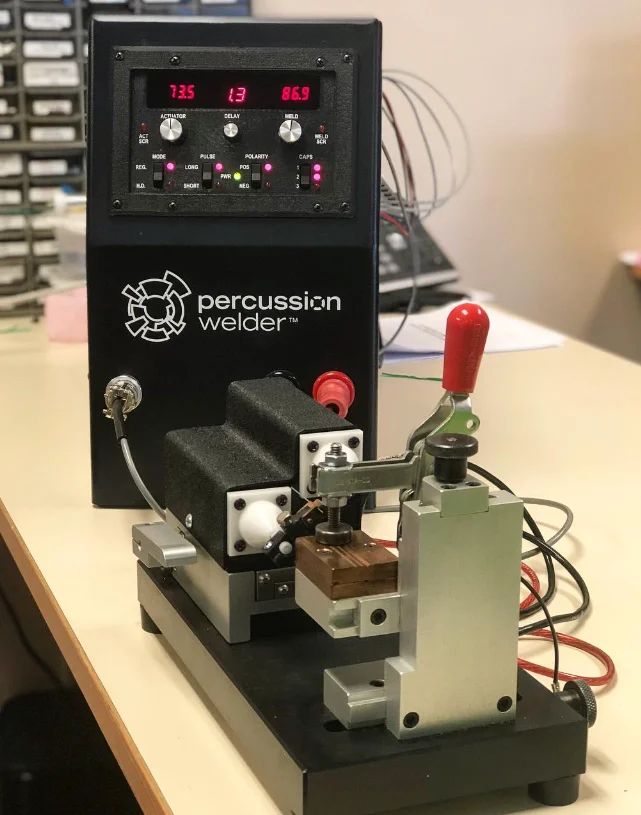 858 and 726 fixture on the bench
Chapter 01 / 07
How percussion welding works
Percussion welding is a capacitor-discharge arc process. Two parts are brought to a pre-set gap, an arc melts the surfaces, the molten surfaces are driven together and the parts bond within milliseconds, with no filler, flux or solder. These videos explain it at the bench.
- The first video above is the company's own "How it works" video.
- A short video on how the Percussion Welder works. Free applications tests are available
- How the Percussion Welder works: a walkthrough at the bench
For the written version, see how it works.
Chapter 02 / 07
Operating and setting up the welder
The Model 858 Percussion Welder is the controller and power supply, and the Model 726 Bench Fixture holds the parts. These videos show how to operate the welder, how to set it up and what the controls and fixture do.
- The YouTube videos are titled "How to operate", "Setup" and "Walk through".
- Step by step: how to operate the Percussion Welder
- A walkthrough of the Percussion Welder power supply adjustments
- A walkthrough of the Percussion Welder bench fixture
Want to see it on your parts?
Send samples and we'll run test welds before you commit.
Gallery
Stills from the weld videos
Select a still to play the video.

Chapter 03 / 07
Copper and wire to stainless steel and steel
Copper to steel and wire to steel are among the weld tests we have filmed. These videos show copper and copper-based wire welded to stainless steel and to steel, in slow motion and at close range under the microscope.
- Slow motion: copper wire percussion welded to a piece of stainless steel
- 18 AWG copper wire percussion welded to a stainless steel tube
- The process of welding a stranded copper wire to a stainless tube, including a look at where the wire breaks in testing
- Extreme close-up of 14 AWG, 42-strand 27% nickel-clad copper wire being micro welded to 304 stainless steel
Chapter 04 / 07
Stranded and fine wire welds
Percussion welding butt welds stranded wire to stranded or solid wire, and works on fine wire. These samples show stranded and solid copper wire joined in several combinations.
- Percussion welding a 22 AWG stranded tinned copper wire to a resistor with a .022" lead
- Slow motion: 22 AWG tinned copper wire percussion welded to .020" solid tinned copper wire
- Slow motion: 18 AWG stranded tinned copper wire percussion welded to 17 AWG copper clad steel
- 18 AWG stranded tinned copper wire percussion welded to 17 AWG copper clad steel, with a close-up of the weld
More on this joint type is on the wire joining page.
Chapter 05 / 07
Aluminum, titanium and Inconel
These videos show aluminum, titanium and Inconel wire welded with the Percussion Welder, which joins metals without filler.
- 20 AWG soft aluminum wire percussion welded to 22 AWG tinned copper
- Joining a stranded copper wire to an aluminum disk, with a microscope close-up of the finished weld. Sound on
- Slow motion: titanium wire butt weld
- Two strands of .034" Inconel joined together with the Percussion Welder
The weld schedules cover 33 materials, and the material compatibility checker shows how a pair is rated.
Want to see it on your parts?
Send samples and we'll run test welds before you commit.
Chapter 06 / 07
Pull tests
A pull test pulls the welded wire until something fails. In percussion welds the wire often breaks before the weld, and these videos show where it broke.
- Pull test of a copper wire percussion welded to a stainless steel device
- 18 AWG stranded tinned copper wire welded to 17 AWG copper clad steel wire, then pulled to failure. Breaks at 46 lbs
- 20 AWG brass wire percussion welded to a .015" steel strip, followed by a pull test. The wire broke above the weld at 32 lbs
The "20AWG to Brass" YouTube video above is the company's own title for that sample.
Chapter 07 / 07
Dissimilar materials, automation and design
The Percussion Welder joins dissimilar metals. These videos show dissimilar materials welded at the bench, a screw welded to a washer and the welder used in automation and semi-automation.
- How the Percussion Welder helps you weld dissimilar materials, with a demonstration at the bench. Copper, nickel and aluminum are shown
- Three different materials, aluminum, nickel and copper, welded and arranged into a stick figure, with the Percussion Welder tagline "Change what's possible."
- The Percussion Welder can be used in automation and semi-automation. Collin at the bench
- Slow motion: percussion welding a screw to a washer, a common micro weld for automotive components
Read more on dissimilar metal welding.
Where to next
How It Works
Percussion welding in four stages: load to a set gap, arc, percussive thrust of molten surfaces, and a bond in milliseconds with no filler material.
Open →Material List Send
No perfect match in the compatibility data? Fill out the form, we email shipping details, and you send materials for a complimentary compatibility evaluation.
Open →858 Percussion Welder
The Model 858 is a capacitor discharge micro welder for thermocouple wire, fine wire and dissimilar metals. No filler, minimal HAZ. Call 303-536-7838.
Open →FAQ
Can I see my materials welded?
Yes. Free applications tests of your materials are available, and we can run live, in-person tests at our lab in Denver. Send a material list through our <a href="/material-list-send/">material list form</a> or call 303-536-7838.
What do the videos cover?
How the Percussion Welder works, how to operate and set it up, walkthroughs of the power supply and the bench fixture, and weld samples including copper to stainless steel, stranded wire, aluminum, titanium, Inconel, pull tests and dissimilar materials.
Why do the pull test videos matter?
In pull tests of percussion welds the wire often breaks before the weld. The pull test videos show wire pulled to failure so you can see where it breaks.
Are the weld settings shown in the videos?
The videos show the welds and the process. For settings, use the <a href="/weld-schedules/">weld schedules</a> as a starting point. They are lab-tested starting points, not guarantees, and every application is validated on your own parts.
Who do I talk to about what I saw?
Call 303-536-7838 or email sales@percussionwelder.com and the team will answer questions about the process or your application.
Still have a question? Tell us your weld challenge and an engineer will reply.
Start here
Send your materials for a free applications test, or come to our Denver lab for a live test.
Prefer to talk? Book a demo or call 303-536-7838