
Thermocouple welding
K, J, T, E, N, R, S, B
thermocouple types the 858 welds
0.001–0.040"
wire diameters (858 specification)
13
lab schedules for thermocouple alloys
0
filler, solder or flux
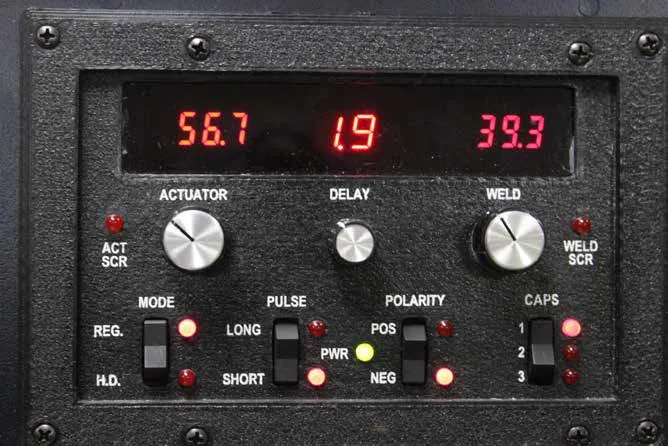
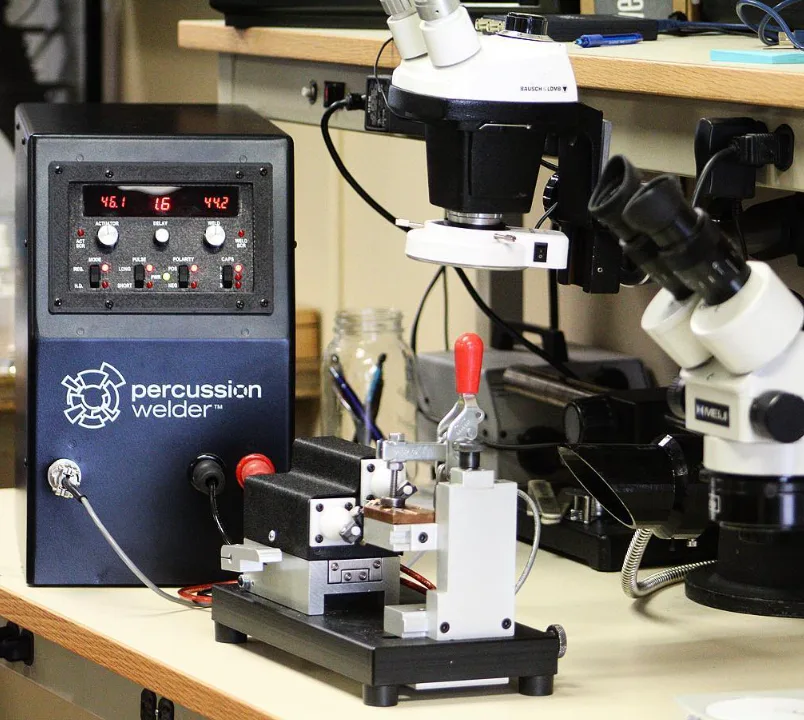 858 and fixture at the microscope station
Chapter 01 / 06
What a thermocouple welder does
A thermocouple measures temperature using the voltage produced when two dissimilar metals are joined and one end is heated. The quality of the weld between the two wires matters: it has to form a clean, consistent junction without adding a third material.
A thermocouple welder is a machine made for that job. Percussion Welder's Model 858 joins the two wires with a capacitor-discharge arc and a rapid percussive thrust, so the junction is made only of the wire metals: no filler, no solder and no crimping.
Chapter 02 / 06
How a percussion welder forms a thermocouple junction
You set the gap, the weld energy and the timing, and the system forms the weld. The electrical arc melts both wire ends at the same moment, and the percussive motion forces the molten ends together into a butt weld. Joints resist shock and vibration.
- Two wires are loaded with their ends brought to a pre-defined gap.
- An electrical arc is generated between the ends.
- Both ends become molten and are thrust together in the percussive phase, creating a full bond.
- Within milliseconds, the wires are welded together without any filler material.
The heating time is short and the heat-affected zone is minimal, so the wire is left with little or no negative effect from the weld.
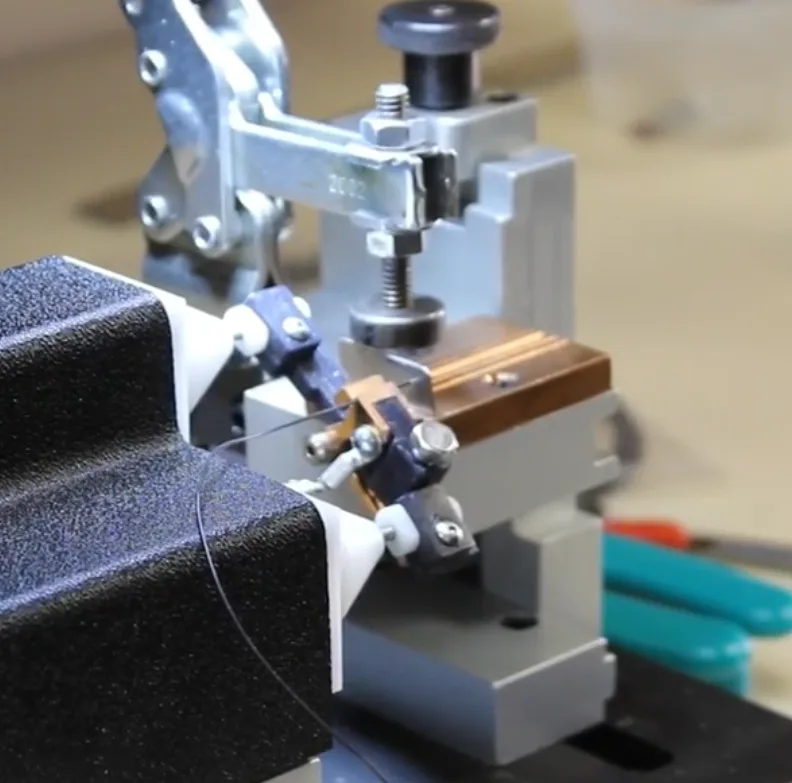 Fine wire in the fixture
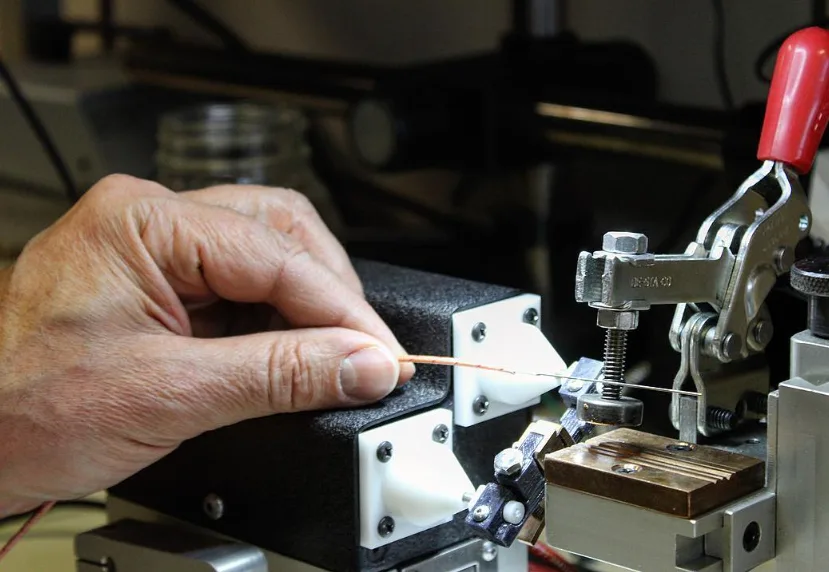 Loading a wire into the fixture
Want to see it on your parts?
Send samples and we'll run test welds before you commit.
Gallery
Thermocouple welding at the bench
The 858, the 726 bench fixture and fine-wire welds.

Chapter 03 / 06
Thermocouple types and wire sizes
The 858 welds thermocouple wire of Types K, J, T, E, N, R, S and B, as well as exotic thermocouple alloys. It handles both the base metals used in general-purpose thermocouples and the noble metals preferred for high-temperature work.
Wire diameters from 0.001" to 0.040" are covered by the 858 specification, including fine instrument-grade conductors. Material combinations beyond the lab database can be developed on request.
Chapter 04 / 06
Lab-tested schedules for thermocouple alloys
These are starting settings from our lab for thermocouple and resistance alloys (13 schedules across 8 material pairs). Each is a starting point, not a guarantee: vary one parameter at a time and test the result.
| Materials | Wire dia. (in) | Velocity (V) | Delay (ms) | Cap | Voltage (V) | Pulse |
|---|---|---|---|---|---|---|
| Alumel to Alumel | .012" | 70 | 1.25 | 2 | 80 | Long |
| Alumel to Alumel | .032" | 78 | 2.50 | 3 | 40 | Long |
| Chromel to Chromel | .032" | 62 | 2.00 | 3 | 55 | Long |
| Copper to Chromel | .030" | 55 | 2.50 | 3 | 50 | Short |
| Copper to Chromel | .040" | 55 | 2.00 | 3 | 50 | Short |
| Nickel to Chromel | .020" | 62 | 2.00 | 3 | 80 | Long |
| Platinum to Copper | .010" | 48 | 1.50 | 2 | 50 | Long |
| Platinum to Copper | .014" | 48 | 1.50 | 2 | 55 | Long |
| Copper to Platinum | .025" | 78 | 1.50 | 2 | 55 | Long |
| Copper to Platinum | .032" | 25 | 1.50 | 2 | 60 | Long |
| Nickel to Kanthal | .015" | 70 | 1.00 | 2 | 50 | Short |
| Tungsten to Nichrome | .010" | 48 | 5.00 | 2 | 40 | Long |
| Platinum to Platinum | .010" | 78 | 1.00 | 1 | 70 | Long |
The database does not currently list a Chromel-to-Alumel schedule, the combination used in a Type K thermocouple. If that is your junction, send us wire samples and we will develop and verify a schedule for you. You can also look up any pair in the Parameter Finder or browse all schedules in the weld schedules table.
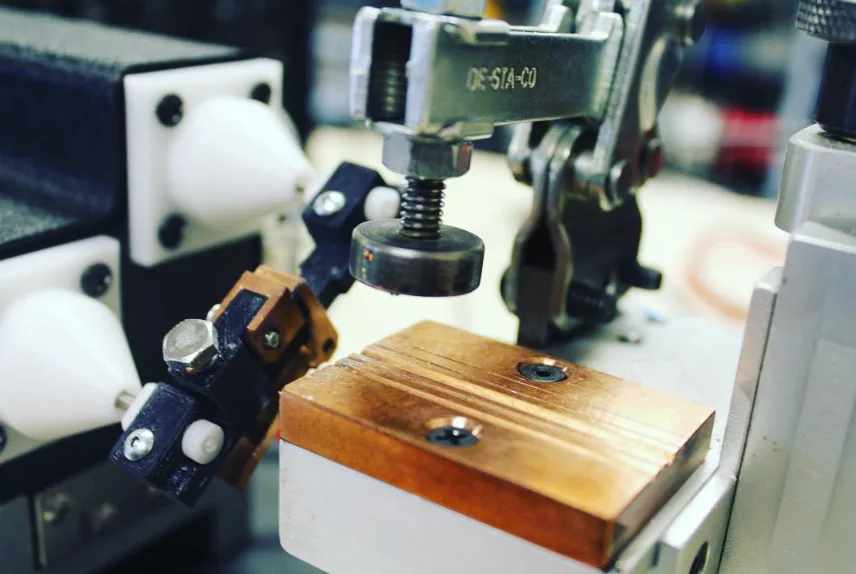 The 726 fixture up close
Chapter 05 / 06
The 858 system for thermocouple work
The system pairs the Model 858 Percussion Welder, which provides the energy and controls, with the Model 726 Bench Fixture, which holds and aligns the wires and applies the rapid motion. Dial controls set the actuator, delay and weld-energy voltage, and switches select mode, pulse width, polarity and capacitance.
An optional Percussion Weld Monitor checks welds for good/no-good quality control. The system can be integrated into automated production lines for high-volume thermocouple production.
See the Model 858, the 726 Bench Fixture and the Percussion Weld Monitor for specifications.
Want to see it on your parts?
Send samples and we'll run test welds before you commit.
Chapter 06 / 06
Try it on your own wire
Bring your most challenging thermocouple project, or send samples. We offer free applications tests, and we can run live, in-person tests at our lab in Denver. Describe what you are joining and we will tell you straight whether percussion welding is a fit.
Where to next
858 Percussion Welder
The 858 Percussion Welder Front panel makes micro-welding simple with the advanced features any type of micro welding is possible. Call us on 303-536-7838 for more details.
Open →Thermocouple
The 858 Percussion Welder Front panel makes micro-welding simple with the advanced features any type of micro welding is possible. Call us on 303-536-7838 for more details.
Open →726 Bench Fixture
The 726 Bench Fixture is the “weld head” of the MTI Percussion Welder system. When combined with the Model 858 Percussion Welder the system provides everything required for producing consistent, reliable weld joints. Call us on 303-536-7838 for more details.
Open →Parameter Finder
Open →FAQ
What is a thermocouple welder?
A thermocouple welder is a precision welding machine that joins the two dissimilar wires forming a thermocouple junction, such as Type K, J or T.
The 858 uses a capacitor discharge to fuse the wires in milliseconds without filler material, contamination or heat damage to the wire.
How is a percussion welder different from a micro spot welder?
A micro spot welder presses two materials between electrodes and passes current through them. A percussion welder uses a capacitor to discharge a controlled burst of energy across a small gap, then drives the molten ends together.
That means no electrode contact pressure, and a minimal heat-affected zone.
Which thermocouple types can the 858 weld?
Types K, J, T, E, N, R, S and B, plus exotic thermocouple alloys. Both base-metal and noble-metal wire are covered.
What wire sizes does it handle?
The 858 is specified for 0.001" to 0.040" diameter wire. Tooling and process adjustments for thinner or thicker material are available on request.
Where do I find starting weld settings for my wire?
Use the Parameter Finder to see lab-tested starting settings for your material pair and wire diameter. They are starting points, not guarantees: vary one setting at a time and test.
If your pair is not in the database, send us samples for a free applications test.
Does the operator need to be certified?
No. The 858 is designed for intuitive manual operation with minimal training. For production environments we provide operator training, weld parameter documentation and the optional Percussion Weld Monitor for good/no-good checking.
Still have a question? Tell us your weld challenge and an engineer will reply.
Start here
Tell us the types and wire sizes. We'll run a free applications test and tell you straight whether percussion welding fits.
Prefer to talk? Book a demo or call 303-536-7838