
Insights
June 9, 2025 · 2 min read · Thermocouple / Electronics
In automotive engineering, precise temperature measurement in extreme conditions—such as turbochargers and exhaust systems exceeding 900°C—drives innovation. This guide explores the fabrication of Type N thermocouples using NiCrSil (Nickel-Chromium-Silicon) and NiSil (Nickel-Silicon) wires, leveraging percussion welding with argon shielding to enhance reliability and performance.
Chapter 01 / 08
Understanding Thermocouple Fundamentals
Thermocouples rely on the Seebeck effect, generating a voltage proportional to the temperature gradient across a welded junction. Type N thermocouples, with NiCrSil and NiSil, offer stability up to 1260°C, resisting oxidation and green rot—essential for exhaust environments. Key considerations include:
- Accuracy: A compact weld reduces thermal mass, enabling ±1°C precision.
- Durability: The weld must endure 1000+ thermal cycles and vibrational stress.
- Conductivity: Low resistance ensures consistent signal integrity.
Welding fine-gauge wires (20–30 AWG) requires overcoming their differing melting points and thermal sensitivities, a challenge mitigated by argon-shielded percussion welding.
Chapter 02 / 08
The Science of Percussion Welding with Argon
Percussion welding combines a microsecond electrical arc with a controlled percussive force, creating a metallurgical bond in under 3ms while minimizing the heat-affected zone (HAZ). Argon shielding, an inert gas, prevents oxidation during the arc, preserving the alloys’ integrity. Advantages include:
- Precision: Adjustable parameters (velocity, time, voltage, capacitance) tailor the weld with argon protection.
- Cleanliness: Argon eliminates contamination, ensuring pure welds.
- Scalability: Ideal for high-volume production with repeatable results.
The process aligns wires with a 0.010–0.040-inch gap, initiates an arc under argon, and fuses the tips with a percussive strike—evident in the attached weld images.
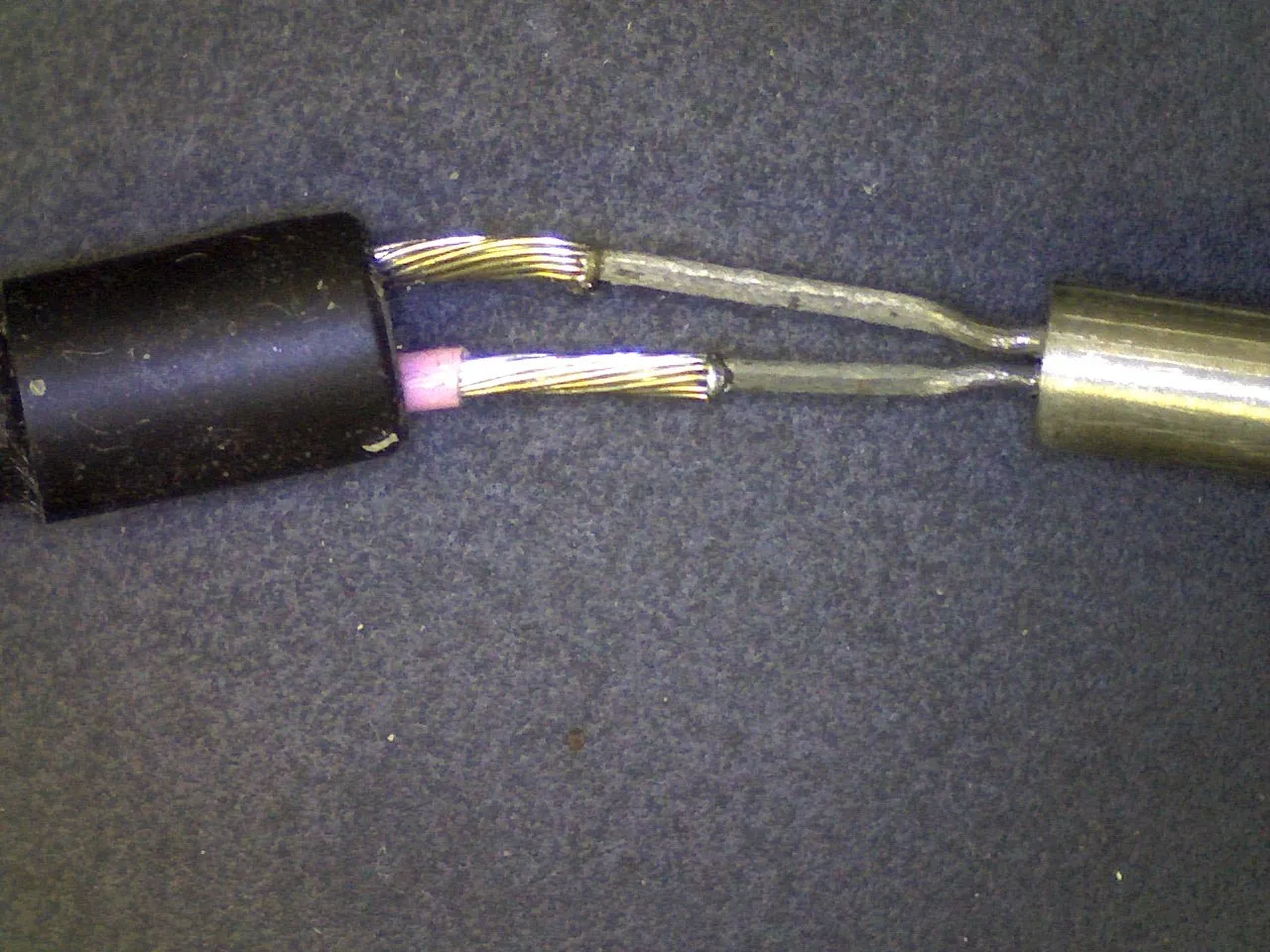
Thermocouple weld assembly showcasing NiCrSil and NiSil junction under argon.

Close-up of NiCrSil sensor weld, highlighting argon-protected precision.
Want to see it on your parts?
Send samples and we'll run test welds before you commit.
Chapter 03 / 08
Optimizing Weld Schedules
A well-defined weld schedule, enhanced by argon, is critical for thermocouple success. The following baseline targets a 0.025-inch (24 AWG) NiCrSil to NiSil junction:
| Material | Wire Diameter | Velocity (V) | Time (ms) | Cap | Voltage (V) | Pulse |
|---|---|---|---|---|---|---|
| NiCrSil to NiSil | 0.025 in (24 AWG) | 70 | 1.1 | 3 | 55 | Long |
Argon shielding is applied during the arc to prevent oxidation. Vary one parameter (e.g., voltage 50–60V) and test tensile strength (~450 psi) and weld uniformity, as shown in the images.
Chapter 04 / 08
Data-Driven Insights with Visualization
Chart compares baseline (blue) and optimized ranges (red). How does argon flow rate influence weld quality?
Chapter 05 / 08
Case Study: Exhaust Sensor Evolution
A turbocharged engine sensor at 950–1000°C used a Type N thermocouple. Initial welds under argon showed HAZ issues, resolved by tweaking voltage to 70V and time to 1.1ms, reducing failures by 30%. Results: ±1°C accuracy, 1000-cycle durability, and 40% throughput increase.
Want to see it on your parts?
Send samples and we'll run test welds before you commit.
Chapter 06 / 08
Weld Quality and Failure Analysis
Weld quality depends on tensile strength (>400 psi), bead symmetry, and continuity. Argon shielding minimizes oxidation-induced failures like cracking. X-ray or thermal imaging could reveal subpar welds, raising questions about argon consistency.
Chapter 07 / 08
Advanced Applications and Future Considerations
Beyond exhausts, argon-shielded percussion welding suits hybrid engines or aerospace sensors. Could automated argon flow control enhance weld repeatability? The technique’s potential warrants further study.
Chapter 08 / 08
Benefits and Challenges
- Robustness: Argon protects against oxidation.
- Scalability: High-volume potential.
- Challenge: Argon setup requires precision.
Intrigued? Contact us for a live demo or custom weld schedules to tackle your challenges!
Part of: Thermocouple Welding
More on thermocouple welding
Thermocouple Industry Hub →FAQ
What is percussion welding?
A heat-plus-impact process for joining metals.
An electric arc supplies the heat, then a rapid mechanical movement forces the two materials together, forming a full metallic bond with no filler.
Do I need filler metal, solder or flux?
No. There's no filler, solder or flux, and no electrodes to wear out.
That means cleaner joints, less waste, and no consumables to buy.
How do I know if my materials can be welded?
Start with the Parameter Finder or the weld schedules table.
If your pair isn't listed, tell us your weld challenge. We'll reply with a straight answer about whether percussion welding is a fit, and how.
Still have a question? Tell us your weld challenge and an engineer will reply.
Start here
Share what you're joining and what's going wrong. We'll tell you straight whether percussion welding is a fit.
Prefer to talk? Book a demo or call 303-536-7838