Battery welding
No filler
no solder or flux either
Dissimilar
metals joined directly
20
lab schedules for battery metals
Automation
integrates into production lines
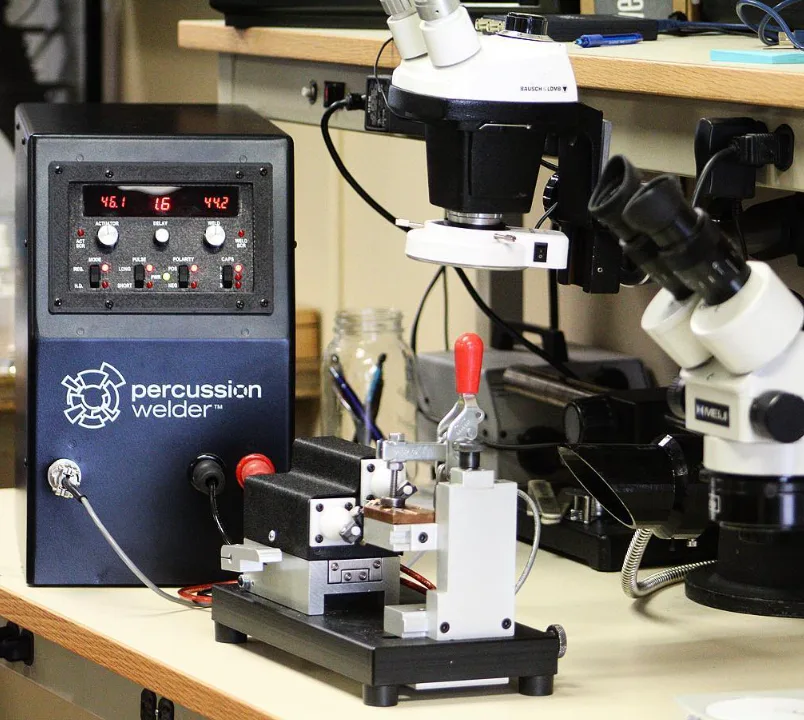 858 and fixture at the microscope station
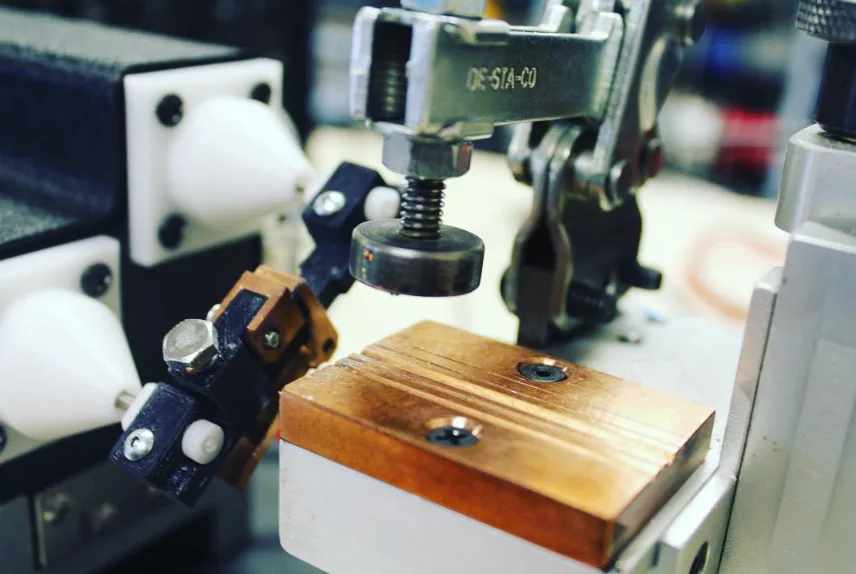 The 726 fixture up close
Chapter 01 / 05
Why battery tabs are hard to weld
Batteries need several metals joined to build cells and connect them to wires and components. The combinations are often dissimilar, such as copper to nickel or aluminum to copper, and the joint must be strong and low in electrical resistance without putting too much heat near the cell.
Percussion welding joins dissimilar materials and fine wires directly, with a minimal heat-affected zone, and without filler material.
Chapter 02 / 05
How percussion welding makes a battery tab weld
A small gap between the two parts allows an electrical arc, which melts the materials. The percussive motion then pushes the molten surfaces together into a complete, filler-free bond.
- The parts are loaded with their weld points at a pre-defined gap.
- An electrical arc is generated between the materials.
- Both surfaces become molten and are thrust together in the percussive phase.
- Within milliseconds, the parts are welded together without any filler material.
Actuator control, delay, weld energy, mode, pulse width, polarity and capacitance can all be set, so each weld can be tuned to the application.
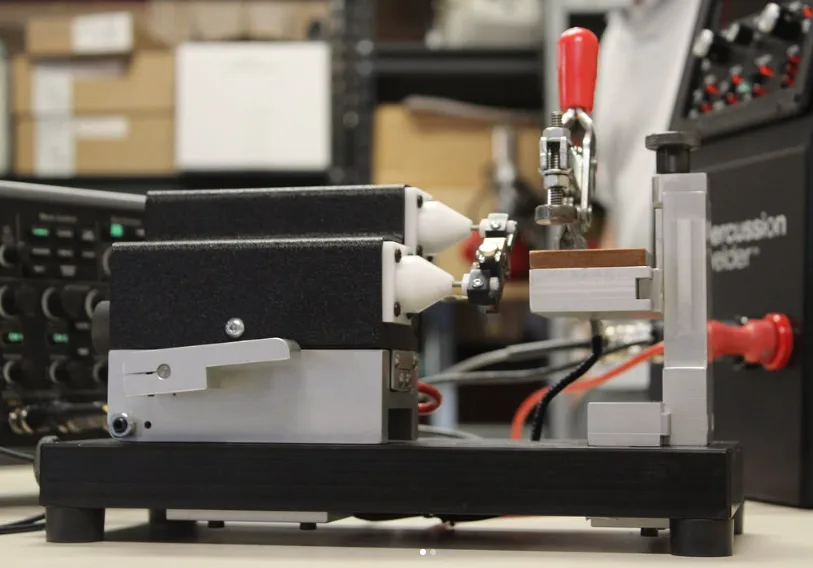 726 bench fixture, side view
Want to see it on your parts?
Send samples and we'll run test welds before you commit.
Gallery
On the bench
The 858, the 726 bench fixture and fine-wire welds.

Chapter 03 / 05
Material combinations tested in our lab
Our weld-schedule database includes 20 schedules for 8 battery-related material pairs. Each is a starting point, not a guarantee. The schedules are listed by wire diameter; for your tab thickness and geometry, send samples for a free applications test.
| Materials | Wire dia. (in) | Velocity (V) | Delay (ms) | Cap | Voltage (V) | Pulse |
|---|---|---|---|---|---|---|
| Copper to Aluminum | .010" | 62 | 1.00 | 2 | 45 | Short |
| Copper to Aluminum | .020" | 62 | 1.00 | 3 | 40 | Short |
| Aluminum to Copper | .025" | 62 | 2.00 | 3 | 55 | Long |
| Copper to Aluminum | .030" | 48 | 1.50 | 3 | 45 | Short |
| Aluminum to Copper | .040" | 93 | 2.00 | 3 | 70 | Long |
| Aluminum to Nickel | .062" | 155 | 6.00 | 3 | 45 | Short |
| Aluminum to Steel | .032" | 124 | 1.00 | 3 | 65 | Short |
| Copper to Nickel | .018" | 70 | 1.50 | 3 | 70 | Short |
| Copper to Nickel | .025" | 62 | 1.00 | 2 | 55 | Long |
| Nickel to Copper | .025" | 78 | 1.00 | 3 | 45 | Long |
| Nickel to Copper | .032" | 62 | 2.00 | 2 | 45 | Long |
| Copper to Nickel | .040" | 48 | 2.00 | 3 | 65 | Short |
| Nickel to Copper | .040" | 70 | 1.50 | 3 | 60 | Long |
| Stainless Steel to Copper | .030" | 93 | 0.50 | 3 | 70 | Long |
| Copper to Steel | .030" | 40 | 1.50 | 3 | 50 | Short |
| Copper to Steel | .040" | 62 | 1.50 | 3 | 50 | Short |
| Nickel to Iron | .025" | 78 | 2.00 | 3 | 55 | Short |
| Nickel to Iron | .040" | 62 | 2.00 | 3 | 75 | Short |
| Nickel to Stainless Steel | .025" | 78 | 1.50 | 3 | 65 | Long |
| Nickel to Stainless Steel | .060" | 48 | 2.00 | 2HD | 50 | Long |
Look up any pair in the Parameter Finder, or see the pair guides for copper to aluminum and nickel to copper.
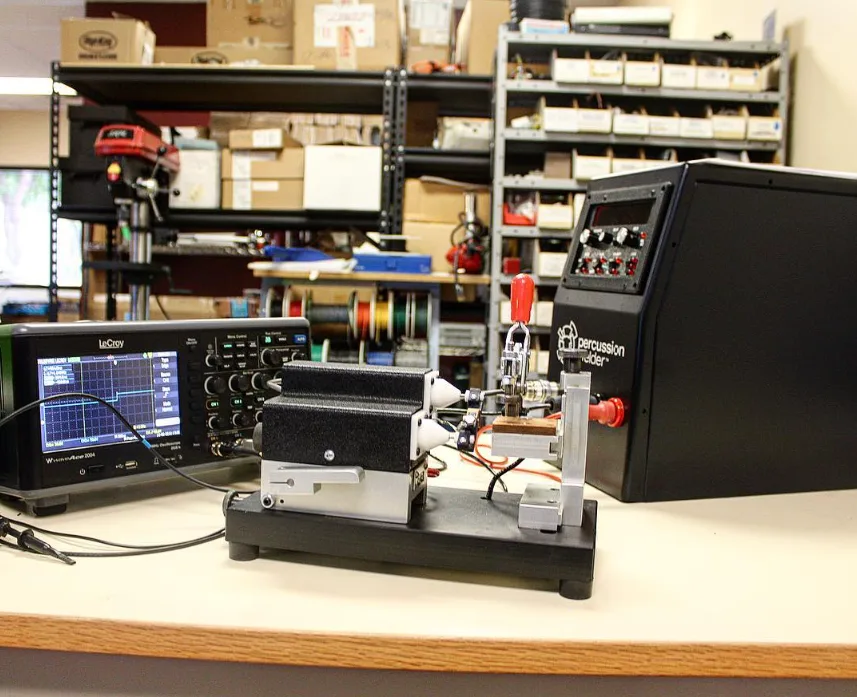 858, 726 fixture and oscilloscope on the bench
Chapter 04 / 05
From prototype to production
The Percussion Welder system can be fully integrated with automated production lines, so manufacturing rates can be maintained in high-volume battery production. The optional Percussion Weld Monitor builds a signature waveform from learned welds and checks later welds against it, giving a pass/fail result with digital outputs for alarms or automation.
For prototypes and development work, the 858 with the 726 Bench Fixture is built for manual operation. See the battery solutions page for more.
Chapter 05 / 05
Get a free test on your battery metals
Send us the metals and thicknesses you are joining. We offer free applications tests, and we can run live, in-person tests at our lab in Denver. Describe your joint and we will tell you straight whether percussion welding is a fit.
Where to next
Battery
The 858 Percussion Welder Front panel makes micro-welding simple with the advanced features any type of micro welding is possible. Call us on 303-536-7838 for more details.
Open →858 Percussion Welder
The 858 Percussion Welder Front panel makes micro-welding simple with the advanced features any type of micro welding is possible. Call us on 303-536-7838 for more details.
Open →726 Bench Fixture
The 726 Bench Fixture is the “weld head” of the MTI Percussion Welder system. When combined with the Model 858 Percussion Welder the system provides everything required for producing consistent, reliable weld joints. Call us on 303-536-7838 for more details.
Open →Parameter Finder
Open →FAQ
Which battery metals can percussion welding join?
Copper, nickel and aluminum are the common battery-tab metals, and percussion welding joins dissimilar combinations of them directly. Our lab database holds schedules for copper to nickel, aluminum to copper, aluminum to nickel and several others.
Does battery tab welding need filler, solder or flux?
No. The weld is made only from the two base metals: no filler, no solder and no flux.
How much heat goes into the cell?
Heating lasts only milliseconds and the heat-affected zone is minimal, which is why percussion welding is used on heat-sensitive assemblies. The effect on any specific cell design has to be confirmed by testing.
Can it run in high-volume production?
Yes. The Percussion Welder system can be integrated with automated production lines, and the optional Percussion Weld Monitor provides good/no-good checking.
Where do I find starting settings for my tabs?
The lab schedules are listed by wire diameter. Use the Parameter Finder for starting settings on your material pair, then send samples of your own tab material and thickness for a free applications test.
Still have a question? Tell us your weld challenge and an engineer will reply.
Start here
Tell us the metals and thicknesses. We'll run a free applications test and tell you straight whether percussion welding fits.
Prefer to talk? Book a demo or call 303-536-7838