
Refractory metals
3,017 °C
tantalum melting point (pure metal)
10
lab schedules involving tantalum
4
refractory metals in the lab database
No filler
no flux, no solder
Two strands of .034" Inconel joined together with the Percussion Welder.
Dissimilar metals
The melting-point gap
Joining metals that melt at very different temperatures is where conventional welding struggles. Choose two metals to see the gap.
Melting points are handbook values for the pure metals, rounded. Alloys melt over a range and differ from the pure metal.
Lab data
Refractory metals: what we have tested
Tantalum, niobium, molybdenum and tungsten, and the metals they are welded to.
Explore
Hover or tap a cell to see how many lab schedules we have for that pair, and open the starting settings.
Counts are lab weld schedules (starting points, not guarantees). A zero means no published schedule yet, not that the pair cannot be welded.
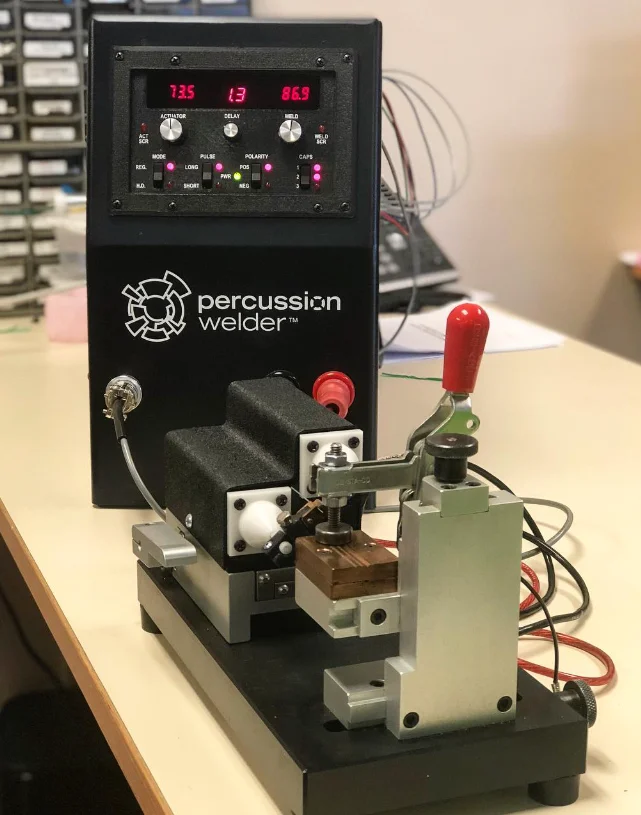 858 and 726 fixture on the bench
Chapter 01 / 07
Welding tantalum
Tantalum is a ductile refractory metal with a very high melting point, about 3,017 °C for the pure metal. It is valued where corrosion resistance matters and is used in applications such as capacitor anodes and corrosion-resistant chemical equipment. Joining it to other metals, such as the copper or nickel conductors that connect to it, is the usual challenge.
Percussion welding joins tantalum directly to a second metal in milliseconds, with no filler, flux or solder. Our lab database holds 10 schedules involving tantalum, across 4 partner materials.
Chapter 02 / 07
Why refractory metals are hard to weld
Tantalum, niobium, molybdenum and tungsten share these difficulties:
- Very high melting points. Tantalum melts at about 3,017 °C, niobium about 2,477 °C, molybdenum about 2,623 °C and tungsten about 3,422 °C. Bringing a refractory metal to its melting point takes a lot of energy, even for small wire.
- They oxidize readily when hot. That is why conventional welding of these metals is usually done in a vacuum or under inert gas shielding.
- A large gap to the partner metal. Copper melts at about 1,085 °C and nickel at about 1,455 °C. Tantalum to copper is a gap of roughly 1,900 °C.
Try the gap picker below with your own pair. Melting points are rounded handbook values for the pure metals.
Want to see it on your parts?
Send samples and we'll run test welds before you commit.
Gallery
On the bench
Fine-wire welds and the fixture that makes them. The footage shows our process, not specific tantalum parts.

Chapter 03 / 07
How percussion welding approaches them
Percussion welding creates a micro arc that provides the heat, then a rapid mechanical movement forces the materials together. The surfaces become molten and are thrust together in the percussive phase, creating a full bond. Within milliseconds, the two materials are welded together without any filler material.
Because the heating lasts only milliseconds, there is very little time for heat to spread into the material around the joint. See how heating time changes heat spread in the heat spread calculator, and the process step by step on how it works.
Percussion welding is a small-scale process: fine wire, pins and thin material. Thick sections and large joints are outside its reach.
Chapter 04 / 07
Lab schedules for tantalum and the refractory metals
These are the material pairs involving tantalum, niobium, molybdenum or tungsten that we have tested on the 858. Each is a starting point, not a guarantee, and every application is validated on the customer's own parts.
| Material pair | Lab schedules | Wire sizes tested |
|---|---|---|
| Copper to Tungsten | 5 | .015", .020", .030", .050", .063" |
| Nickel to Tantalum | 5 | .012", .013", .018", .019", .025" |
| Niobium to Tungsten | 4 | .025", .026", .030", .040" |
| Copper to Molybdenum | 3 | .018", .030", .050" |
| Copper to Tantalum | 3 | .007", .016", .030" |
| Nickel to Tungsten | 3 | .030", .040", .060" |
| Aluminum to Molybdenum | 2 | .005", .010" |
| Stainless Steel to Tungsten | 2 | .020", .053" |
| Aluminum to Tungsten | 1 | .006" |
| Dumet to Molybdenum | 1 | .060" |
| Dumet to Tungsten | 1 | .020" |
| Iron to Molybdenum | 1 | .012" |
| Kovar to Molybdenum | 1 | .012" |
| Molybdenum to Nickel | 1 | .015" |
| Molybdenum to Nickel Iron | 1 | .062" |
| Nichrome to Tungsten | 1 | .010" |
| Nickel Silver to Tantalum | 1 | .023" |
| Silver to Tungsten | 1 | .020" |
| Steel to Tungsten | 1 | .012" |
| Tantalum to Tantalum | 1 | .015" |
Tantalum schedules in full:
| Materials | Wire dia. | Velocity (V) | Delay (ms) | Cap | Voltage (V) | Pulse |
|---|---|---|---|---|---|---|
| Nickel to Tantalum | .013" | 78 | 0.75 | 2 | 55 | Short |
| Nickel to Tantalum | .019" | 93 | 0.75 | 3 | 65 | Short |
| Nickel to Tantalum | .025" | 79 | 1.50 | 2 | 55 | Long |
| Tantalum to Copper | .007" | 48 | 2.00 | 1 | 55 | Short |
| Tantalum to Copper | .016" | 78 | 1.00 | 2 | 75 | Short |
| Tantalum to Copper | .030" | 78 | 2.00 | 2 | 75 | Long |
| Tantalum to Nickel | .012" | 62 | 3.50 | 2 | 60 | Short |
| Tantalum to Nickel | .018" | 62 | 3.00 | 2 | 55 | Short |
| Tantalum to Nickel Silver | .023" | 48 | 3.00 | 2 | 50 | Short |
| Tantalum to Tantalum | .015" | 62 | 1.50 | 2 | 60 | Short |
Open any pair in the Parameter Finder, or browse the weld schedules table. Pair guides: Tantalum to copper · Niobium to tungsten · Copper to tungsten · Nickel to copper.
Chapter 05 / 07
Preparing the surfaces
Clean and degrease both materials and remove oxides, oils and contamination from the weld area. Notes from our process team:
- Tantalum: clean thoroughly. Avoid contamination.
- Niobium: clean thoroughly. Avoid contamination.
- Molybdenum: clean thoroughly. Remove any surface contamination.
- Tungsten: clean the surface carefully. Remove any oxidation.
Vary one setting at a time and pull-test each result. Validate joint strength on your own parts before production.
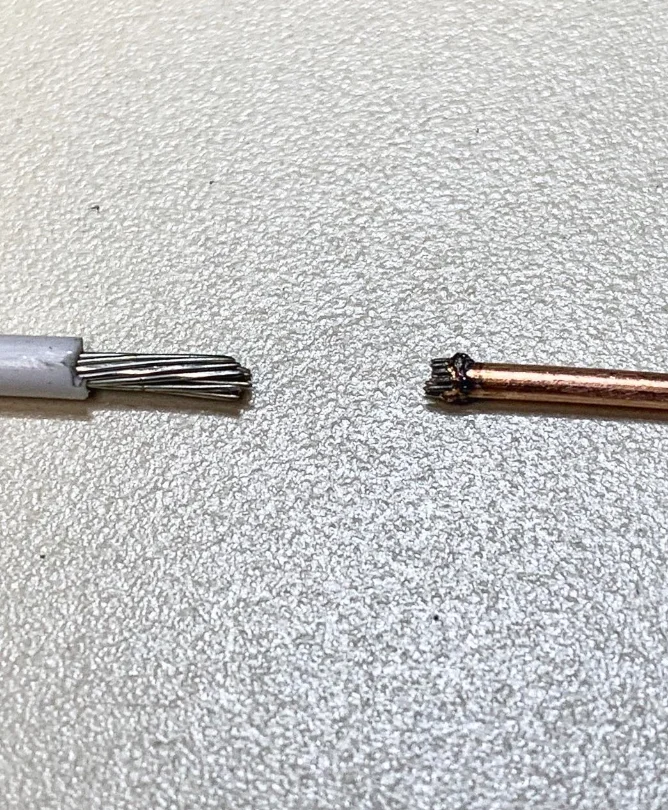 Wire ends on the bench
Want to see it on your parts?
Send samples and we'll run test welds before you commit.
Chapter 06 / 07
Is percussion welding right for your tantalum part?
It is worth a test when:
- the parts are small, such as fine wire, pins or thin foil;
- tantalum has to join a different metal, such as copper or nickel;
- heat has to stay out of a sensitive part nearby;
- no filler, flux or solder is acceptable in the joint.
If another process suits the part better, we will tell you. Check your pair in the material compatibility checker.
Chapter 07 / 07
Send us your tantalum parts
Send the metals and the wire, foil or pin sizes. Free applications tests of your materials are available, and we can run live, in-person tests at our lab at 7100 N Broadway in Denver. Call 303-536-7838 or tell us your weld challenge.
FAQ
Can tantalum be welded?
Yes. Tantalum is a ductile refractory metal that welds with the right process. It melts at about 3,017 °C and oxidizes readily at high temperature, which is why conventional welding of tantalum is usually done in a vacuum or under inert gas shielding.
Our lab has 10 percussion welding schedules involving tantalum. Ask how percussion welding fits your part.
Can tantalum be welded to copper?
Yes. We have 3 lab schedules for tantalum and copper, in wire sizes .007", .016", .030". The metals melt about 1,932 °C apart, and percussion welding joins them directly with no filler.
Can tantalum be welded to nickel?
We have 5 lab schedules for nickel and tantalum, in wire sizes .012", .013", .018", .019", .025".
Do I need a vacuum or shielding gas?
Tantalum oxidizes readily when hot, so shielding matters for conventional welding. How that applies to your part depends on the joint and the application. Send us your parts and we will test and tell you what we find.
Which refractory metals are in your lab data?
Tantalum (10 schedules), niobium (4), molybdenum (10) and tungsten (19), each paired with the metals listed on this page. Lab settings are starting points, not guarantees.
How do I get my tantalum part tested?
Send the part or the material and sizes. Free applications tests of your materials are available, and we can run live, in-person tests at our lab in Denver. Call 303-536-7838.
Still have a question? Tell us your weld challenge and an engineer will reply.
Start here
Tell us the metals and the wire or foil sizes. Free applications tests of your materials are available.
Prefer to talk? Book a demo or call 303-536-7838